

Graham Henry recently made the point in an interview with Martin Devlin that Super Rugby doesn’t prepare for international rugby because, amongst other reasons, there are simply not enough development opportunities for young players. With just 5 NZ SRP teams and most of the top All Blacks playing at home, there are neither enough games nor places for young players to get any sort of significant game time.
As a result, you have players reaching the highest levels who have barely figured at the immediate level below. Wallace Sititi had played just 680 minutes of Super Rugby (13 appearances but less than 9 full games in terms of minutes) before getting capped, George Bell 727 minutes, Pasilio Tosi 791 minutes, Noah Hotham 851 minutes. Kyle Preston had just played 469 minutes of Super Rugby before appearing against the Springboks at Eden Park.
Later in the interview Devlin tried to go against Ted’s argument for the importance of player rotation by saying that “we shouldn’t hand out All Blacks jerseys”. But looking at these numbers of playing minutes, that’s exactly what’s been happening, and this for more than a few years now.
In order to get a fuller sense of Henry’s argument, I’ve looked at the age profile of Super Rugby teams, comparing them to their counterparts in Europe (Champions Cup) and Japan (JRLO). I’ve also tried to map out what opportunities are available to young players, tracing the playing minutes of U21 players across these teams (all stats used are from all.rugby).
What becomes apparent is that, from a development perspective, there are some serious structural issues within the NZ rugby pyramid which are clearly impacting the ability of the national team to perform to the best of its abilities. I’ll conclude by briefly reflecting on the South African case, arguing that for Henry’s vision to work the NZR would have to go even beyond what SARU are currently doing. Whether that's realistic I'll leave to others more in the know.
Matchday squads age profile: Super Rugby Pacific compared to Europe and Japan
What kind of competition is Super Rugby Pacific in terms of age profile? In order to get a better sense of this, we can compare the different SRP matchday squads (Round 9) with their counterparts in Europe and Japan, looking at the average ages of forwards and backs from the Round of 16 of the Champions Cup and Round 14 of the JRLO. What quickly becomes apparent is that SRP is by no means an old man’s competition.
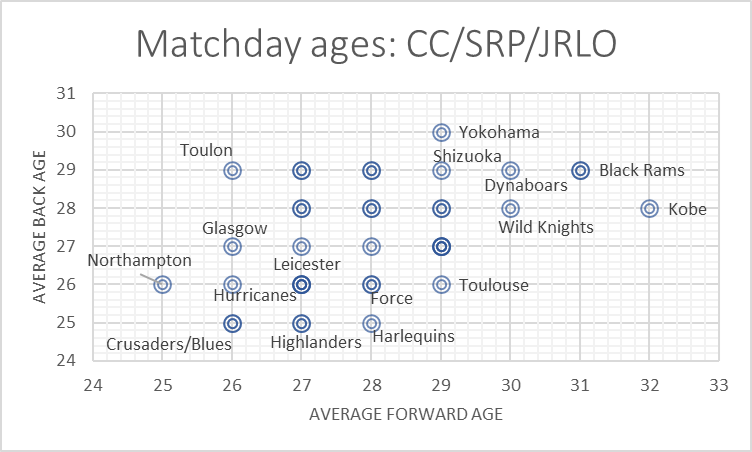
The average of forwards and backs in matchday squads across SRP, the Champions Cup and the JRLO
While there is a lot of variation within competitions like the Top 14 and the Premiership – Toulouse having an experienced forward pack and a youthful backline, with Toulon having the opposite for their clash with the Stormers – the Japanese and Super Rugby competitions are on clear opposite ends of the spectrum. The SRP sides consistently have some of the youngest matchday squads whereas in Japan the teams have a lot more experienced heads running around. Interestingly, Dave Rennie’s Kobe had the oldest average age of all the matchday squads, his forwards being around 32 years old while his backs averaged out at 28.
By contrast, the Blues, Crusaders (SRP) and Northampton Saints had the youngest matchday squads, Northampton picking a very youthful forward pack for their game against Castres while the Crusaders and the Blues picked youth in the backline. Looking at the competitions as a whole, this pattern is re-established, especially for Kiwi SRP sides.

The competitions compared on the basis of the average age of a matchday squad
Again, the same picture appears: the Japanese league is by far the oldest on average while the NZ teams are typically the youngest, both in the pack and amongst the backline. When looking at the NZ SRP teams, it does become more obvious that SRP is essentially a development competition, where players play in their mid-twenties before either becoming capped All Blacks or moving away overseas.
This is an issue, especially for the forwards, as the prime ages for these players are around 28 or 29. When looking at the graph above, it seems as though the Top 14 is getting that balance right in the Champions Cup, with an average age for their forward packs just above 28 years old. While teams like the Blues and Crusaders will be able to put up more experienced packs come the playoff rounds, it does show a lack of depth in experience across those sides.
Still, as I will show below, this does not mean that SRP provides plenty of playing opportunities for young players. Rather, it shows the vision of a competition which has an incredibly tight window of high performance – between the ages of 22 and 27 – after which a definitive selection is made on which players will remain in the competition (ABs) and who will move overseas. Players who take a bit longer to reach their peak or who require different environments to get to the top of their game – think Jamison Gibson-Park – will most likely end up playing Test rugby elsewhere. Looking at the struggles with halfback depth behind Roigard (Hotham, Ratima, Fakatava, Preston), this is far from an ideal situation.
U21 minutes across competitions
Before I can get to the actual numbers of U21 minutes played, some remarks are first in order. First, why focus on U21s? I believe the years between 18 and 21 are a crucial period of player development, with the first steps of professionalism being undertaken. Yet this period, ironically enough, often goes paired with a distinct lack of consistent rugby, with players bouncing around between all kinds of playing environments (U19s, U20s, club rugby, provincial rugby, national rugby, and so on) without getting the opportunity to settle for a longer period of time.
And this brings me to a second point: the way different competitions engage with their U21 players varies greatly. In Europe, you have big Top 14 and Premiership academies, where players play and compete alongside each other for a number of years. While this can be a lonely and alienating experience for players in its own right, what it does provide is consistency. In Super Rugby Pacific, you can get a development contract or you can be selected in the main squad outright. The academy system is mostly associated with the NPC sides yet it seems unlikely to me (although feel free to correct this) that these teams have the proper facilities available to organize continuous development for those players who fall outside of these SRP contracts.
With this in mind, we can look at the total playing minutes of U21s (i.e. being born on January 1st 2005 or later) across these competitions from this current season. Despite just having the data for 4 Top 14 and 7 Premiership teams (in comparison to 11 SRP and 12 JRLO teams), these two comps stand out substantially in terms of afforded playing minutes to U21 players.
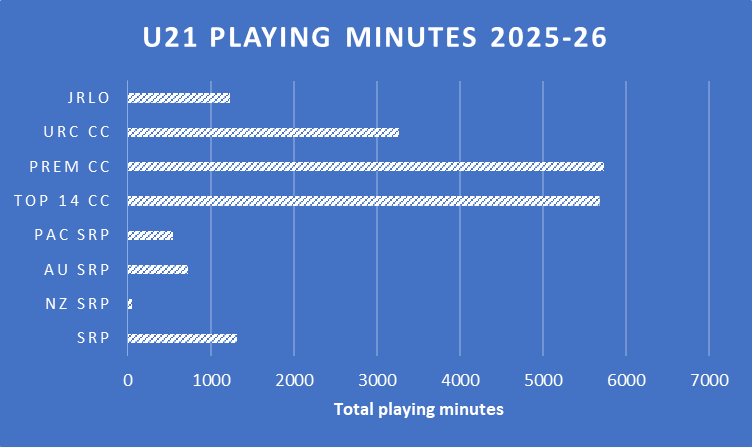
The 7 Prem teams (Northampton, Bath, Saracens, Bristol, Harlequins, Sale and Leicester) and 4 Top 14 teams (Toulon, Toulouse, Castres, Bordeaux) have a massive advantage on their competitors (data last checked on the 16th of April ’26)
So what exactly is going on here? There are currently 9 U21 players contracted to NZ SRP teams (see table below). Of those, only Manumaua Letiu has received any playing minutes so far this season (51’ in total), with Tito-Harris joining him in Round 10 after his debut for the Highlanders off the bench at Eden Park. These numbers might’ve been different if Pledger hadn’t gotten injured in preseason but it’s still quite a small number of players regardless, with the Hurricanes having no one from ’05, their youngest current player contracted being Vernon Bason (’04 birth).
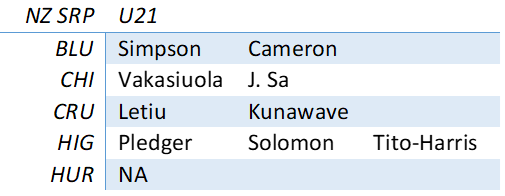
The NZ U21 players contracted to SRP teams
The gap in playing opportunities becomes really visible when we compare this playing group to the U21 players already used this season by the 4 French R16 Champions Cup teams.
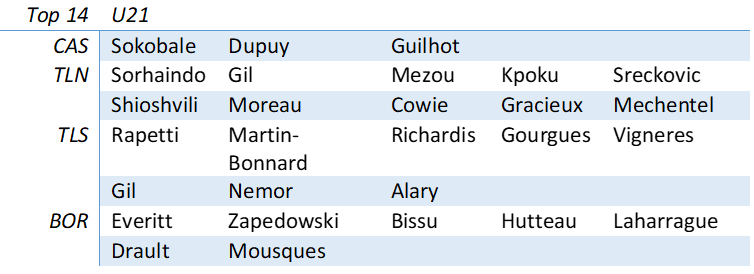
The 28 U21 players who have received gametime for 4 Top 14 clubs this season
These players are different from their Kiwi counterparts in that they are typically not contracted to the senior side but are part of the academy. What they do receive, however, is game time: all of these players have played either Top 14 or Champions Cup, the highest levels you can reach below Test level.
Of course, not all of these players are the same: someone like Colin Dupuy (CAS) has only played 4 senior minutes this season, whereas Kalvin Gourgues (TLS) has become a regular in the Toulouse midfield (1212 minutes). Similarly, what is noticeable is how many different nationalities appear in the French youth system: there are South Africans (Everitt), Englishmen (Kpoku) and Georgians (Shioshvili) but also Polish players (Zapedowski) and those who represent Spain at international level (Richardis). It’s the globalizing rugby market at work.
The reason why so many Top 14 U21s get playing minutes is twofold: it is due to the immense investments being put into the academies and it is further made possible by the sheer amounts of games available. With a maximum of 29 possible games in the Top 14, as well as another potential 12 Champions Cup matches, certain Top 14 teams play 35+ games per season which necessitates rotation and massive available squads. Teams like Toulouse, Bordeaux, Northampton and Leinster all have excellent academies which allows them to bring through game-ready youngsters, giving the next generation game time while still holding onto some of the biggest names in the sport.
The SA case: so has Rassie got it right?
Throughout his interview with Devlin, Graham Henry waxed lyrical about SARU’s current approach to things, referring to the depth, playing opportunities and team culture created by Rassie Erasmus. By allowing wealthy overseas clubs to pay for the best Springboks, so Ted opined, the way is being paved for the next generation to come through.
But while it’s tempting to view the Springbok Test results as a direct reflection of the South African rugby pyramid, the reality is slightly more complex than that. The South African case is quite unique and shows some of the challenges that come even with a higher number of playing opportunities available.
1. Young players still have their pathway blocked
While the South African teams are giving their U21 players more game time compared to the NZ SRP teams, this discrepancy still isn’t as high as it probably should be. For example, despite the fact that the South African teams can play up to 10 more games per season than they did in Super Rugby – the Bulls played 27 games during the 2024-25 season, compared to a maximum of 17 SR games that season – their U21 minutes still lag considerably behind the Top 14.

The four SA teams (Bulls, Lions, Sharks, Stormers) compared to the four Top 14 Champions Cup teams (R16)
And this is despite the fact that multiple U20 World Cup winners are entering into the professional domain, such as Pead, Hlekani, Jooste, Mlaba and Jaco Williams. As South Africa only really has 4 professional rugby teams (plus the semi-pro Cheetahs), there are a huge number of professional journeymen available within South African professional rugby, who are taking up places for more promising young rugby players.
The international rugby market is largely saturated, also due the availability of the top Springboks, who are of course preferred in Japanese rugby. Graham Henry’s ideal of the top ABs being paid for has, then, an unintended side-effect: those fringe SRP players who weren’t good enough for the ABs will most likely lose their contracts and return to Super Rugby Pacific. So if the competition isn’t expanded with more Kiwi teams, those U21 players will still not get any more opportunities than they currently have.
2. Overseas development opportunities are becoming blocked
Henry’s vision of the All Blacks also included them actually developing as rugby players abroad, learning from top clubs on how to become better players and perform on the highest stage. Erasmus undoubtedly had a similar idea yet hit a snag due to these Boks underperforming abroad. Jon Cardinelli, the SA journalist, released a graph last year which clearly showed that certain competitions like the Premiership and the Top 14 had lost their appetite for Springboks, as they couldn’t (or wouldn’t) replicate their Test form for their club teams.

Fewer and fewer Springboks are playing in competitions such as the Premiership and Top 14, with the majority of them playing in Japan (source: Jon Cardinelli: https://www.rugbypass.com/plus/how-the-springboks-are-looking-east-for-a-world-cup-three-peat/)
A player like Pieter-Steph Du Toit is a good example of why paying for the top Springboks is a poisoned chalice for club teams. Since the 2023 Rugby World Cup, Du Toit has played 19 out of 27 Bok Tests (70%), mostly going for the full 80. In that same time period, however, PSDT has played in just 14 club games for Toyota Verblitz, out of a possible 48 (29%).
It seems likely then that his next contract will, once again, be in South Africa, just as it was for Etzebeth, Kolisi, Reinach and Pollard. Thomas Du Toit, arguably the best tighthead in the world right now, is also moving back to South Africa after this season. In an inverse move, Ruan Nortjé, the Bulls lock, is going to Japan at the end of the season, in a move rumoured to be engineered by Rassie in order to make sure his locks are rested enough for the 2027 Rugby World Cup.
So what we are seeing in South Africa is by no means the workings of the free market but something that is carefully being orchestrated by Erasmus. If his idea was to let other cash-rich clubs pay for his top Springboks, it seems fair to say that it hasn’t quite worked out like that.
A different path
So if NZR were to follow in the footsteps of SARU and allow their top ABs to play overseas, they would do well to see how the South African system is far from functioning perfectly. The new generation isn’t coming through effortlessly at professional level and overseas clubs are becoming more and more hesitant in signing expensive Boks. If the ABs were to go in the same direction, these clubs will make sure to communicate their expectations, which is that the club comes first.
And if Graham Henry’s view of the future were to be successful, it will most likely depend on NZR’s ability to create more playing opportunities for young players at the highest levels, expanding both the numbers of teams as well as the number of high-level tournaments these teams participate in. A massive investment in academy systems will also be necessary, if they want these players to be ready for game time when they do eventually get their opportunities in these tournaments.
That all sounds like a massive amount of money needing to be spent. And looking at NZ Rugby’s recent financial policies as well as their inability to get reforms across the bridge, it also sounds like an incredibly unlikely turn of events. The only thing we can hope for is that the current administration has some more nous than the former. At least that shouldn't be so hard.
Tl;dr
Graham Henry’s argument for Super Rugby’s inability to prepare players for Test rugby is built around the lack of playing opportunities available to young players. Analysis of SRP age profiles shows two things: (1) SRP has an incredibly tight high-performance window (22-27) after which a huge number of players leave the competition. And (2) due to a lack of an aligned academy system, SRP teams give essentially no playing time to U21s, this despite the fact that these are key years for professional development.
While Henry points to South Africa’s overseas selection policy as an example to follow, their unique situation has shown its own limitations (limited U21 minutes, diminishing opportunities for top Springboks overseas). It might be worth exploring how a French-style development system (more teams + high investment in academies) could be implemented within the structures of Super Rugby Pacific. While this would require serious funding (as well as dissolving the NPC as a professional competition), without such an investment it is difficult to see how NZR would keep up the pace alongside the rest of the rugby world.
As a warning, I’d recommend watching Squidge Rugby’s latest video on how the situation in Wales has unravelled. Not investing in your own future pretty much equals giving up on it.