Does Super Rugby prepare players for Test Rugby?

Mauss

Does Super Rugby Pacific sufficiently prepare its players for international Test rugby, as far as skills and tactics are concerned? Early evidence suggests a concerted effort across the tournament teams to increasingly mimic the game’s current trends, by emphasizing kicking and especially contestable kicking.

3e349799-7764-42af-8b06-9aeeb8de1124-image.png
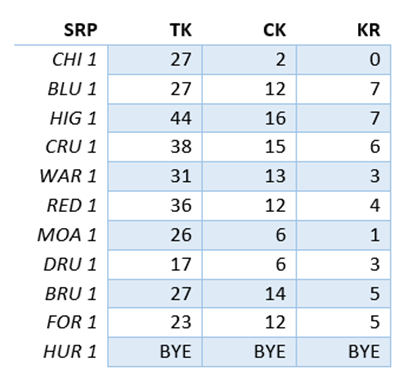
Rd. 1 SRP kicking: total kicks, contestable kicks and kicks retained

At an average of more than 29 kicks per team, the first round of SRP saw a huge amount of kicking. Furthermore, almost 11 of those 29 kicks were contestable, with teams using a variety of box kicks, chips and wipers kicks to create a contest for the space by going to the boot.

[sidenote: my definition of a contestable is relatively broad. Any kick that sees a contest for the ball after a kick, I deem to be a contestable one. So grubbers, cross-field kicks and restarts are included in these numbers, which is different from how others interpret contestable kicks. See, for example, Brad Harris’ analysis on contestable kicking after the 2013 Rugby Championship; https://d26phqdbpt0w91.cloudfront.net/NonVideo/6a3d5727-707e-4970-abb3-ae926c7c9386.pdf]

Comparison with Six Nations
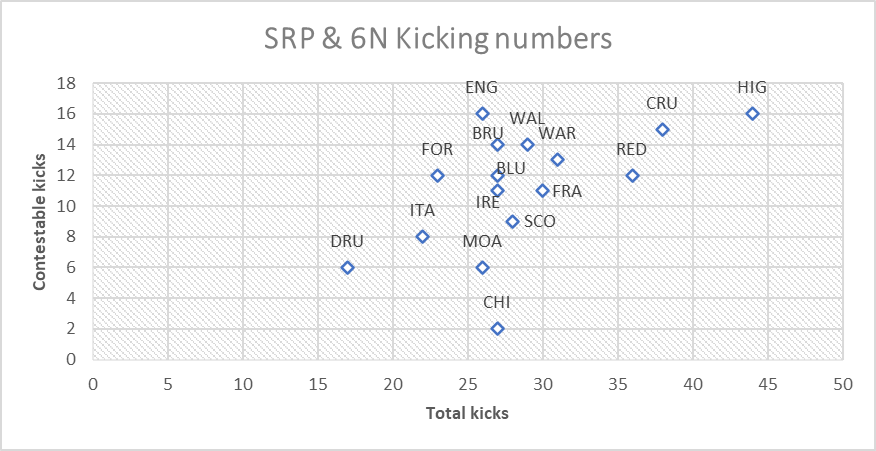
These numbers compare relatively well with those of the Six Nations’ sides, who employ a comparable rate of contestable kicking.

734f8186-e166-4cc9-8304-9ce9a292a662-image.png
Comparison: Total and contestable kicking from SRP (rd. 1) and 6N (rd. 2) sides

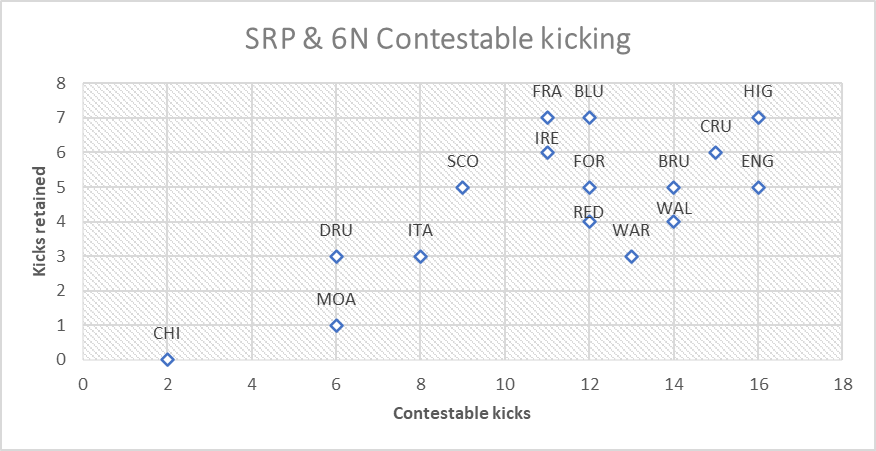
bcf69f42-29eb-4085-877d-b79c3e7ca112-image.png
Comparison: Contestable and retained kicks from SRP and 6N sides

At the moment, it's only the Chiefs who are lagging quite a bit behind in terms of their contestable kicking. For them, it wasn’t so much that they didn’t want to kick contestably but rather that their kicks were consistently too long for any chasers to reach. Neither Roe nor Ratima were accurate enough with the boot for any meaningful kick chase, with only a few of Jacomb’s midfield bombs able to be contested (if unsuccessfully).

Other sides, like the Highlanders, Blues and Crusaders, were able to put up their fair share of contestable kicks, with a good bit of success as well (HIG: 44% retention rate; BLU: 58%; CRU: 40%). These kick retention rates compare favourably with the likes of England (31%), Ireland (54%), and Scotland (55%), all of whom have excellent kickers at their disposal.

The main differences
Still, some gaps between the two tournaments can be discerned. Two clear areas of improvement are, I think, the accuracy of kicking in SRP as well as its (lack of) attacking identity in relation to the kicking game.

In terms of accuracy, the 6N sides are able to kick contestably at a higher rate in fewer kicks, while, at the same time, successfully competing more possessions as well. To put it more simply: the 6N teams are able to do more with less.

9727aa6b-c324-4123-98a2-16baa461221a-image.png
Comparison: averages of kicks (AK), contestables (AC) and retentions (AR), and rates of contestables (%C) and retention (%R) between SRP and 6N sides

In addition to this, we see a further development of clear attacking identities in relation to the prevalence of kicking. For example, England kicks at a higher rate of contestables than anyone else (61%) because they have tied their own attack closely to their kick retention rate. When this kicking game falls flat – like it did against Scotland, with only a retention rate of 31% - much of their attacking game falls apart as well. So while this playing philosophy comes with a great deal of risk, you can at least see clearly what they are trying to do.

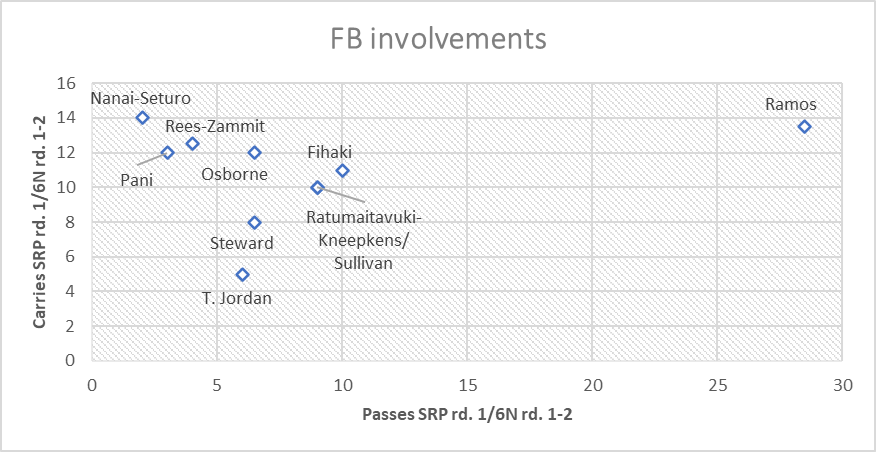
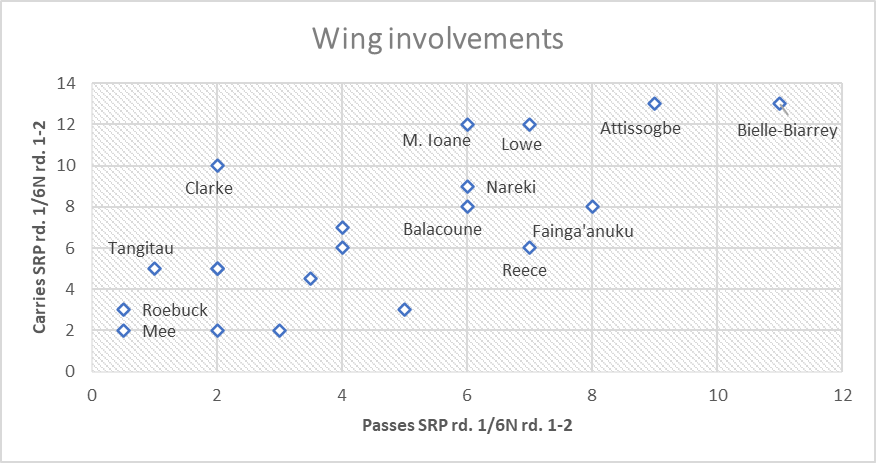
Similarly, France have completely organised their attacking game on the basis of the opposition kicking the ball to them, approaching the kick receipt as a set piece platform from which to launch their own back 3 strike moves. This is clearly visible when comparing the passing involvements of the French back 3 (Ramos, LBB, Attissogbe) to other teams in both the Six Nations and Super Rugby Pacific.

569c118f-f467-498e-bb4c-d78b706399a5-image.png
Attacking involvements from SRP and 6N fullbacks: Ramos is clearly playing a different game to everyone else

dad4e86a-6658-4716-b133-9c34b2fc2666-image.png
Attacking involvements from SRP and 6N wingers: the 6N wingers are currently working harder than their SRP counterparts, involving themselves more in the attack across the field

Ramos, Bielle-Biarrey and Attissogbe are not just faster and more skilled that their opposites, they are also far more involved than them, getting their hands on the ball both as carriers and as passers.

This is the key for the French transition attack: the back 3 of France rarely kicks (Ramos: 3.5 kicks/80) but instead of just carrying the ball back, they make sure to shift the point of attack, passing the ball between them and finding the weak point in the chasing defensive line. No less than 5 Welsh kicks immediately led to French line breaks.

In contrast, across the four NZ teams, just 2 opposition kicks (out of 136) led to line breaks in the first round (both Jordan breaks against the Highlanders). This means that kicking to a NZ team barely represents any threat whatsoever. Until NZ teams find new ways of making teams pay for kicking to them, opposition teams won’t hesitate whatsoever to pepper Kiwi back 3s with high balls, no matter how good they become in the air.

Playing multiple ball players across the back 3 – like France is currently doing with its 3 fullbacks in its back 3 – seems like the easiest current fix to what is a badly broken transition attack.

tl;dr
It seems like the SRP teams are trying to prepare their players more thoroughly for the international arena by integrating the attacking kick more into their arsenal. Still, there is a considerable way to go, both in terms of accuracy and developed identity. SRP teams need to be more creative, in terms of their tactics as well as their selection strategies. Putting together a back 3 of fullbacks, and getting them more involved in the attack, seems like a logical next step.

@Mauss Excellent analysis as always mate, though the conclusions are pretty grim in several ways - both for the game in general and for the ABs.
It is good to see the French taking up what used to be our approach of making the opposition fear kicking to us - to me that is the better approach than us trying to beat them at their own game (not saying we shouldn't improve e.g. our below par kick accuracy, just that a focus on countering it rather than copying it would be nice).
While there has frequently been a bit of talk on here about using AFL coaches to upskill the kick accuracy and ability to contest, one that doesn't get a mention is the way their smaller guys will flood the area around contests at pace to pick up loose ball and immediately distribute it - that is where I think we have a lot to gain, as if you can do that then there are great counter-attack opportunities to be had (and I think the positioning and static nature of our supporting players is one of our biggest weaknesses in this part of the game).

Mauss

@reprobate said in Super Rugby 2026:

Excellent analysis as always mate, though the conclusions are pretty grim in several ways - both for the game in general and for the ABs.
It is good to see the French taking up what used to be our approach of making the opposition fear kicking to us - to me that is the better approach than us trying to beat them at their own game (not saying we shouldn't improve e.g. our below par kick accuracy, just that a focus on countering it rather than copying it would be nice).
While there has frequently been a bit of talk on here about using AFL coaches to upskill the kick accuracy and ability to contest, one that doesn't get a mention is the way their smaller guys will flood the area around contests at pace to pick up loose ball and immediately distribute it - that is where I think we have a lot to gain, as if you can do that then there are great counter-attack opportunities to be had (and I think the positioning and static nature of our supporting players is one of our biggest weaknesses in this part of the game).

Yeah, I think the French are, in many ways, influenced by the 2010s AB attack, where players like Ben Smith and Israel Dagg would take up similar roles in setting up the counter-attack. Another similarity is that this current French team is loaded with excellent link players, both amongst the backs and the forwards, which makes any attacking shape way more dangerous.

The NZ Super teams aren't exactly overflowing with these types of linking players in the back 3 right now, although I do think they are out there. A player like Jona Nareki is now most likely considered to be too old for the ABs but he's always had an excellent skillset and distribution game for a winger. Hopefully, players like Nareki will get more of a shot with the new coaching group.

Duluth

Worth its own thread

I'll have the main website fixed soon so quality posts like this are easy to find

mariner4life

i think the worst kick i saw in any game all weekend was late in the Friday game where the Landers 10 should have cost them the game with what was little more than a slightly high chip kick in teh 22 that was caught uncontested. The end result of the turnover was the Crusaders hitting the front. Just a bad option executed badly.

The point about the French is bang on, they've decided to make that particular contest a launching point. Not only has LBB admitted to working really hard on it, they appear to have dropped the otherwise excellent Penaud for a player more skilled in this area. They get players around the drop zone to pick up spilled ball and immediately move it away. And yes, it helps having the world's best fullback who is brilliant at bringing other players in to the game.

The ABs are locked in to Will Jordan in one back 3 spot (his positives are too good to ignore really when we're not exactly overflowing with excess talent), but he is completely unable to link and bring other players in to the game, what Will does well Will does for Will.

What Mauss's post does highlight is once again we look to be trying to win the last war when others have already moved on.

JA

"Ramos, Bielle-Biarrey and Attissogbe are not just faster and more skilled that their opposites, they are also far more involved than them, getting their hands on the ball both as carriers and as passers."

Just furthering this, the entire French team is extremely switched on to getting the ball to these guys when there's a turnover or a suggestion of space. Kick or pass it's been drilled into them to just get the ball out as quickly as possible. The recognition of where the space makes me very envious compared to our lot last year. It helps to have guys like Jalibert and Ramos who can sum up the numbers, space and options in a microsecond.

Gaultier has rethought their entire strategy since the Autumn games and adapted the team and personnel to fit it. Impressive.

mariner4life

their space isn't clogged with fucking forwards taking far too many touches, holding the ball too fucking long, and dragging the defence to them as well.

canefan

@mariner4life said in Does Super Rugby prepare players for Test Rugby?:

their space isn't clogged with fucking forwards taking far too many touches, holding the ball too fucking long, and dragging the defence to them as well.

You're right. Our offence has been far too fussy. We don't make the ball do the work

Mauss

@mariner4life said in Does Super Rugby prepare players for Test Rugby?:

Not only has LBB admitted to working really hard on it, they appear to have dropped the otherwise excellent Penaud for a player more skilled in this area.

It’s pretty noticeable how cutthroat the top coaches like Erasmus and Galthié currently are in terms of selection. In contrast, a player like Jordan can stagnate in certain crucial areas of back 3 play, yet it seems unimaginable that he would be dropped.

I mean, I like Jordan. I think he’s one of the most talented rugby players in the world. But he runs away from his support and his passing just isn’t up to scratch for what the attack requires right now. A player like Ratumaitavuki-Kneepkens might not have the kind of game- and line-breaking ability Jordan has but what he does have is linking ability and a good understanding of space. I’m not sure the Highlanders would’ve scored their first try if Jordan was the one making the final pass.

Watching the French break the line for fun against both Ireland (13) and Wales (18) (double the line breaks the ABs were able to make against these teams, 6 and 9 respectively) has solidified my feeling that players like Ratumaitavuki-Kneepkens and Damian McKenzie need to be in the back 3. I’m not sure who the third is; but they need pace, distribution skills and a willingness to get involved.

@Mauss I agree that McKenzie is exactly the sort of guy who can both run himself and put people into space which we need in the back 3, but I think he's also (and moreso) needed at 10.
Or are we stuck waiting for Mo'unga still?

In Jordan, Clark and Tangitau we have 3 guys who are all potentially devastating runners, but none are really noted distributors.

Mauss

@reprobate said in Does Super Rugby prepare players for Test Rugby?:

I agree that McKenzie is exactly the sort of guy who can both run himself and put people into space which we need in the back 3, but I think he's also (and moreso) needed at 10.
Or are we stuck waiting for Mo'unga still?

I think, with the new coaching ticket, it’s likely that we’ll see someone else at first five. It could be a fresh face (Love, Reihana, Jacomb) but I think it’s most likely that Mo’unga will be given the keys for the run-up to the World Cup.

I think a Mo’unga-McKenzie combination could work quite well: Mo’unga is a very classic first five who likes his hands on the ball a lot at first receiver (similar to someone like George Ford but with a better running game) while McKenzie is one of the world’s best attacking players at second receiver. Who plays 10 and who plays 15 there is also rather fluid in today’s game: while Jalibert is wearing the 10-jersey for France, he is mostly attacking the line at second receiver while Ramos is the one with the ball in his hands first. It’s all pretty pragmatic.

In Jordan, Clark and Tangitau we have 3 guys who are all potentially devastating runners, but none are really noted distributors.

Jordan-Clarke-Tangitau could be a lethal back 3 but then you have to adjust your game plan accordingly. Emphasizing transition attack with these players isn’t a great idea because, as you say, none of those players are renowned for their passing.

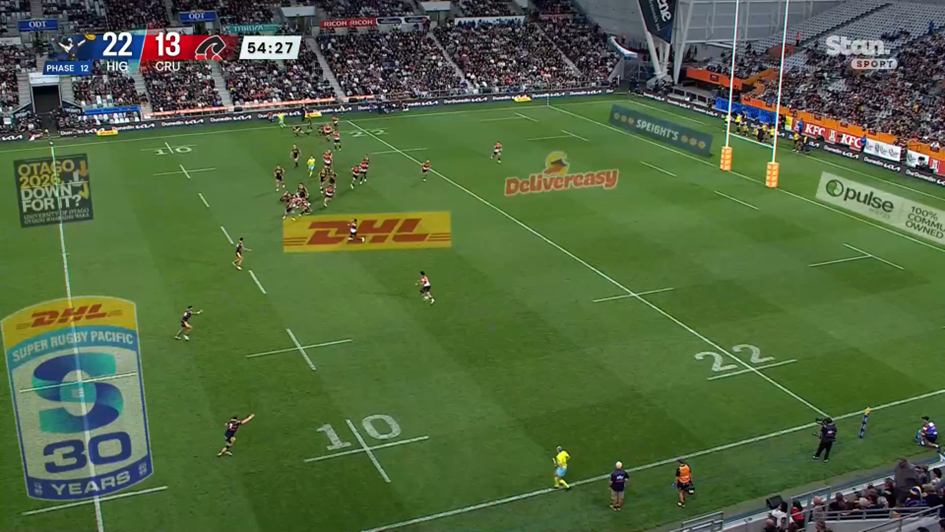
Tangitau showed this very neatly on one occasion against the Crusaders where the Landers had numbers on the right. After Tavatavanawai is able to get the ball away in contact, the only thing Tangitau needed to do was make sure to move the ball along the chain. Instead, he clogs up the space by taking a few steps forward, gets caught man and ball by Ennor and the ball is turned over at the ensuing ruck.

33dc8a45-e6ac-4526-9723-eca0799d6846-image.png
Numbers and space on the right. If the Landers score here, the game would’ve been over much sooner

Players like Tangitau and Clarke would be great in a Schmidt-style possession game where they’re allowed to roam behind the rucks, looking for gaps either in tight or out wide. They would also be great at using their pace for finishing strike moves from set piece, similar to Jordan’s score against Ireland in the World Cup quarter final.

So, I’d be fine with either, as long as selection matches strategy.

canefan

Selection matches strategy. Now there's a novel idea....

jimmyb

@Mauss I remember an article from Nick Bishop a few years ago explaining exactly that re. McKenzie and how much more effective the chiefs attack was with Ioane at 10 and McKenzie at 15.

Imo Dmac does not offer enough due to his physical size to attack the line at 10 in international rugby. If he’s running at the set defence of South Africa, England, France, the players know his only real option is to pass or kick, which puts massive pressure on the receiver.

We need a 10 that can at least hold parity in contact and has the sideways movement to beat defenders in a congested contact zone

Mauss

@jimmyb said in Does Super Rugby prepare players for Test Rugby?:

We need a 10 that can at least hold parity in contact and has the sideways movement to beat defenders in a congested contact zone

That's probably the strongest argument for putting a player like Love at first five. He made 4 line breaks from his five games at 10 last season, which is a very solid return. His injuries worry me, though. He needs time in the saddle more than anything else. I thought it was noticeable that he hadn't played a lot of first five during the '25 season; he was often quite late to be in the position he needed to be.

If he's able to get through a lot of minutes during Super Rugby, I do think players like him and Reihana are genuine options. But they would both need to be paired up with a playmaker, either at 12 or 15. Neither of them are game controlling 10s (yet). But with Roigard and someone like McKenzie in the backline, perhaps they don't need to be.

jimmyb

@Mauss said in Does Super Rugby prepare players for Test Rugby?:

@jimmyb said in Does Super Rugby prepare players for Test Rugby?:

We need a 10 that can at least hold parity in contact and has the sideways movement to beat defenders in a congested contact zone

That's probably the strongest argument for putting a player like Love at first five. He made 4 line breaks from his five games at 10 last season, which is a very solid return. His injuries worry me, though. He needs time in the saddle more than anything else. I thought it was noticeable that he hadn't played a lot of first five during the '25 season; he was often quite late to be in the position he needed to be.

If he's able to get through a lot of minutes during Super Rugby, I do think players like him and Reihana are genuine options. But they would both need to be paired up with a playmaker, either at 12 or 15. Neither of them are game controlling 10s (yet). But with Roigard and someone like McKenzie in the backline, perhaps they don't need to be.

Well exactly. With Roigard and a play making 15, all we need is a 10 that can kick, pass, and square the defence up.

But also what is desperately needed is a 12 that can break the line. J Barrett is a great player but does not offer the line break ability that is needed. That get out of jail ball to a 12 that can make metres when the pressure is on is needed

nostrildamus

@jimmyb said in Does Super Rugby prepare players for Test Rugby?:

But also what is desperately needed is a 12 that can break the line. J Barrett is a great player but does not offer the line break ability that is needed. That get out of jail ball to a 12 that can make metres when the pressure is on is needed

Quinn Tupaea?

@mauss so if we are waiting for Mo'unga for the WC, would the coach want to chuck a newbie in for the SA tour, or go with McKenzie as a more conservative place-holder? I guess if one of them has a storming Super season maybe - but right now Love is injured, Reihana may well share game time with Kemara, and Jacomb is mostly going to be on the bench - so it might be a stretch. (I would say that Mo'unga + McKenzie was always the one dual playmaker option that looked like it might work to me though).

Pairing one of the young guys with a playmaking 12 I'd say yes great, but question who our international quality playmaking 12s actually are? (apart from the near-mythological Higgins). Is Jordie that guy, or are the long levers just a little too slow? Our Super starters seem like Tupaea, Tavatavanawai, Havili and Ahki... Which then makes it look a bit like the loose forward situation: just pick an unnamed big hard-hitting, hard-working ruck-hitting lineout option guy to pair with Savea and Sititi, oh wait...

@jimmyb The Hurricanes had Roigard at 9 and a solid basics 10 in Cameron with a playmaking Love at fullback, and were pretty well beaten by the Brumbies last year. Roigard is good, but he has tended to go into his shell a bit at times - I don't think he is consistent enough to take enough of that playmaking load on himself at international level (yet) to make an e.g. Reihana work. I also don't think our other AB halfbacks really play the game the same way (very unfortunate the Pledger injury) - which also means a change in plan at 60 minutes, and big problems if/when Roigard is injured. And if you want a bruiser at 12, that is likely to increase the playmaking load on 10 too, because a Ma'a Nonu doesn't come around every couple of years.

Mauss

@jimmyb said in Does Super Rugby prepare players for Test Rugby?:

But also what is desperately needed is a 12 that can break the line. J Barrett is a great player but does not offer the line break ability that is needed. That get out of jail ball to a 12 that can make metres when the pressure is on is needed

Just in an effort to try and get this back on topic: if you look at the current 6N lineups, the crash ball off 12 isn’t a massive priority for most teams. Dingwall (ENG, 91 kg), Marin (ITA, 88 kg), Brau-Boirie (FRA, 98 kg) and Hawkins (WAL, 98 kg) are anything but typical crash ball merchants, with most of those players having experience of playing 10 as well. Sione Tuipulotu (SCO, 104 kg) should probably be categorized as something between a playmaker and a carrying threat, while the one side who still picks big, carry-first 12s, Ireland (McCloskey/Aki), is currently struggling to get their attack going (17 points scored on average after 2 rounds).

Instead, what a lot of teams are doing is putting their most dominant gainline back at 13, like England (Freeman/Lawrence), France (Depoortère), Wales (Eddie James), and Italy (Menoncello). (You could argue that Huw Jones belongs in this list as well.) A player like Garry Ringrose – 1 line break after the first two rounds, 33% gainline – bucks this trend but he has been rather anonymous so far, compared to, for example, his performances at the 2023 World cup (1.6 line break per 80 min).

The reason for this shift by teams is pretty simple, I think: you get an extra playmaker at 12 who can facilitate moving the ball away from the point of contact quickly and accurately while you have your dominant carrier running into space instead of into crowded areas.

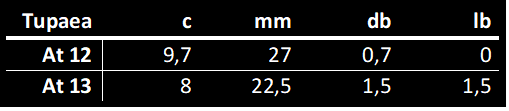
Quinn Tupaea’s increased effectiveness at 13 is a good example of this. While he carries more often and makes more metres at 12, he is a bigger linebreaking threat at 13 at Test level, while also able to beat more defenders.

c7fb3c00-eb91-4ebf-8b0c-7e6b64c09b7d-image.png
Tupaea’s averages from 3 starts at 12 (FRA 3, SCO, ENG) and 2 starts at 13 (AU 2, IRE) for carries, metres made, defenders beaten and line breaks

Having a player like Tupaea, Fainga’anuku or even Tavatavanawai at 13 seems to offer some real advantages: all of these players have the ability to bust through tackles as well as offload in contact, allowing them to set free their outsides. Their chances of creating a line break, either for themselves or for others, are currently higher on the outside edges than in the spaces close to the ruck.

Turning back to Super Rugby Pacific, it’s clear that the SRP sides aren’t particularly eager to follow this trend. Apart from the Blues, who have stuck with AJ Lam (105 kg) at outside centre, most other teams have resisted putting a big body at 13, with the Crusaders preferring Ennor (94 kg) to Fainga’anuku (109 kg) and the Chiefs putting Rona (94 kg) at outside centre rather than putting Tupaea (102 kg) out one wider. With the lack of efficacy from Proctor during the 2025 Test season and the (attacking) success of Tupaea and Fainga’anuku there, it lays bare another area in which there’s not a great deal of alignment between Super Rugby and Test rugby.

As far as 12 is concerned, I think Jordie Barrett still has a head start to the jersey. He’s got a skillset which suits the role of the playmaking 12 well (13.3 passes per 80 min), while not being short of physicality himself (2.2 defenders beaten per 80 min).

0bfae7a6-590b-44b9-aa83-f5463fbdd4c5-image.png
Jordie Barrett’s averages from the 2025 Rugby Championship: carries, metres made, defenders beaten, line breaks, passes and kicks

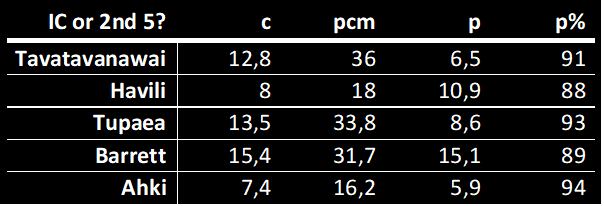
In Super Rugby Pacific, most Kiwi teams retain their dominant gainline back in the 12-jersey (CHI, HIG, BLU), with only the Crusaders and Hurricanes employing a more traditional playmaking second five (equal to or more passes than carries).

dae8220c-bdf2-428f-8242-0bb822f288c2-image.png
Numbers for this week’s starting 12s (stats are from previous SRP season or Champions Cup, in the cases of Barrett and Ahki): carries, post-contact metres, passes and percentage of accurate passing

It would be interesting to see a bit more experimentation from SRP sides in terms of selection, although the Blues’ decision to go for a double gainline midfield is one of those experiments worth keeping a closer eye one. If they can shows signs of clicking, it might pave the way for a similar midfield for the ABs.

mariner4life

all your posts show how dated the AB attack has been. a non-distributing lump at 12, a centre playing on his shoulder with no room to distribute, generally a loose forward between the centre and the winger. A non-distributing 15, a 10 who sat in the pocket and passed.

@mariner4life said in Does Super Rugby prepare players for Test Rugby?:

all your posts show how dated the AB attack has been. a non-distributing lump at 12, a centre playing on his shoulder with no room to distribute, generally a loose forward between the centre and the winger. A non-distributing 15, a 10 who sat in the pocket and passed.

Don't forget the props in the 9-10-12 axis bro, you're underselling it.

Duluth

@mariner4life said in Does Super Rugby prepare players for Test Rugby?:

all your posts show how dated the AB attack has been. a non-distributing lump at 12, a centre playing on his shoulder with no room to distribute, generally a loose forward between the centre and the winger. A non-distributing 15, a 10 who sat in the pocket and passed.

It's even weirder than that, the 15 was meant to be a distributor but they asked Jordan to do it. The pass out the back was usually to the 15 and he had to link with the wingers

It was the Foster template which was better suited to a 10 at 15. Also time had moved on and defences were very comfortable against it

taniwharugby

@mariner4life and for a period, had the fastest guy on the park at 13, but used him to crash the ball up...we really have helped our demise over the past half dozen or so years.

@Duluth said in Does Super Rugby prepare players for Test Rugby?:

@mariner4life said in Does Super Rugby prepare players for Test Rugby?:

all your posts show how dated the AB attack has been. a non-distributing lump at 12, a centre playing on his shoulder with no room to distribute, generally a loose forward between the centre and the winger. A non-distributing 15, a 10 who sat in the pocket and passed.

It's even weirder than that, the 15 was meant to be a distributor but they asked Jordan to do it. The pass out the back was usually to the 15 and he had to link with the wingers

It was the Foster template which was better suited to a 10 at 15. Also time had moved on and defences were very comfortable against it

It's more a reverse-Foster I reckon: instead of having a 2nd 10 at 15, we had a 2nd 15 at 10... didn't go so well.

One of the nice things about the Blues success was them doing it with a (for NZ Super) different, tight, forward-focused game plan. Such a shame that team has been dismantled so quick. Maybe I'm just an old fluffybunny, but I miss the days when e.g. Waikato were all forward grunt and Otago would go to great lengths to keep the ball moving to avoid their forwards being dominated - having to deal with that sort of variety in opposition I think gives players (and coaches) a broader skillset, and e.g. a big Blues pack dominating for a few years would encourage teams to select big forwards to combat them, rather than half our teams having what should be big loosies playing at lock, and 3 small-medium loose forwards.

canefan

@reprobate said in Does Super Rugby prepare players for Test Rugby?:

@Duluth said in Does Super Rugby prepare players for Test Rugby?:

@mariner4life said in Does Super Rugby prepare players for Test Rugby?:

all your posts show how dated the AB attack has been. a non-distributing lump at 12, a centre playing on his shoulder with no room to distribute, generally a loose forward between the centre and the winger. A non-distributing 15, a 10 who sat in the pocket and passed.

It's even weirder than that, the 15 was meant to be a distributor but they asked Jordan to do it. The pass out the back was usually to the 15 and he had to link with the wingers

It was the Foster template which was better suited to a 10 at 15. Also time had moved on and defences were very comfortable against it

It's more a reverse-Foster I reckon: instead of having a 2nd 10 at 15, we had a 2nd 15 at 10... didn't go so well.

One of the nice things about the Blues success was them doing it with a (for NZ Super) different, tight, forward-focused game plan. Such a shame that team has been dismantled so quick. Maybe I'm just an old fluffybunny, but I miss the days when e.g. Waikato were all forward grunt and Otago would go to great lengths to keep the ball moving to avoid their forwards being dominated - having to deal with that sort of variety in opposition I think gives players (and coaches) a broader skillset, and e.g. a big Blues pack dominating for a few years would encourage teams to select big forwards to combat them, rather than half our teams having what should be big loosies playing at lock, and 3 small-medium loose forwards.

The Blues played the prototypical test game. Direct forward orientated play, a 10 who drove them around the park and gave the ball early so his outsides could cook, kicked his goals. What is so wrong with wanting all of that in our ABs? You aren't alone in that sentiment

Mauss

A big talking point in the previous Test season was the (lacking) skills of the ABs. I would argue that it is in this area where the value (or lack thereof) of competitions like Super Rugby Pacific lies. It’s the players’ club competitions which foster skillsets, not the Test team, as there simply isn't enough time at that level to properly nurture such skills. The question then becomes: is there alignment between the skillsets built within these competitions and the Test team’s strategy? Are the sufficient skills available to the coach to play the kind of style they want to implement?

International playing styles
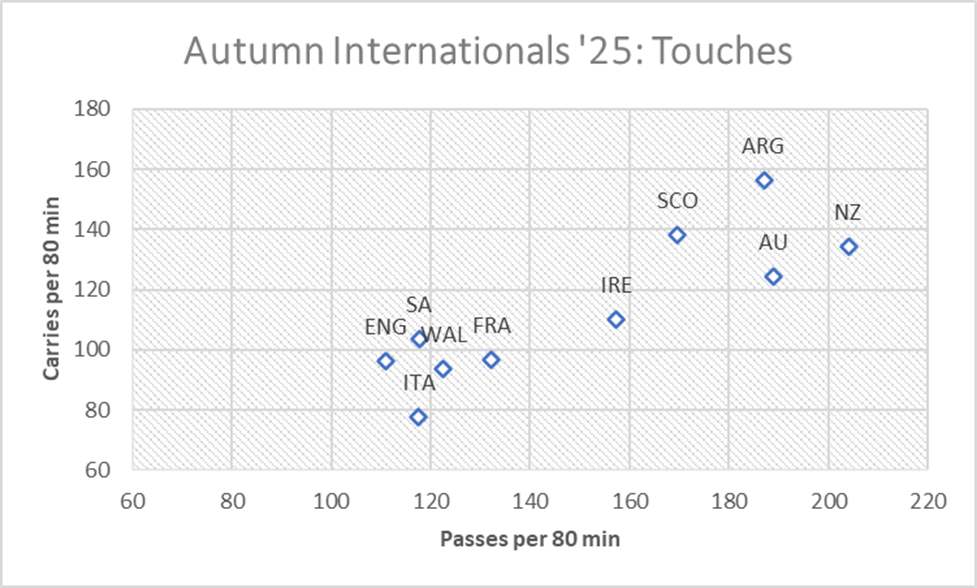
If we take a quick look at some stats from the Autumn Internationals, it is clear that there is a clear divide between the sides who want to play ball-in-hand (SCO, NZ, AU, ARG), and those that want to play without (SA, ENG, FRA, WAL, ITA).

5b898cc3-442b-42bb-a72d-47855135321d-image.png
Ireland’s positioning – awkwardly between these two groups – is rather curious, and perhaps indicative of their identity struggles during the Autumn

New Zealand was the side that passed the most while Argentina carried more than anyone else, Contepomi’s Leinster influences still running strong throughout the team. England passed the least while Italy had fewer average carries than anyone else, with these teams preferring the aerial contest and defensive dominance as means to pressure the opposition.

Of course, these numbers aren’t set in stone. The last round of the Six Nations shows that teams do try to go outside of their templates – England passing the ball 193 times against Ireland – but these ventures can lead to rather disastrous results. We can expect the men in white to swiftly return to the kick against an Italy that will look to dominate them physically.

The NH competitions
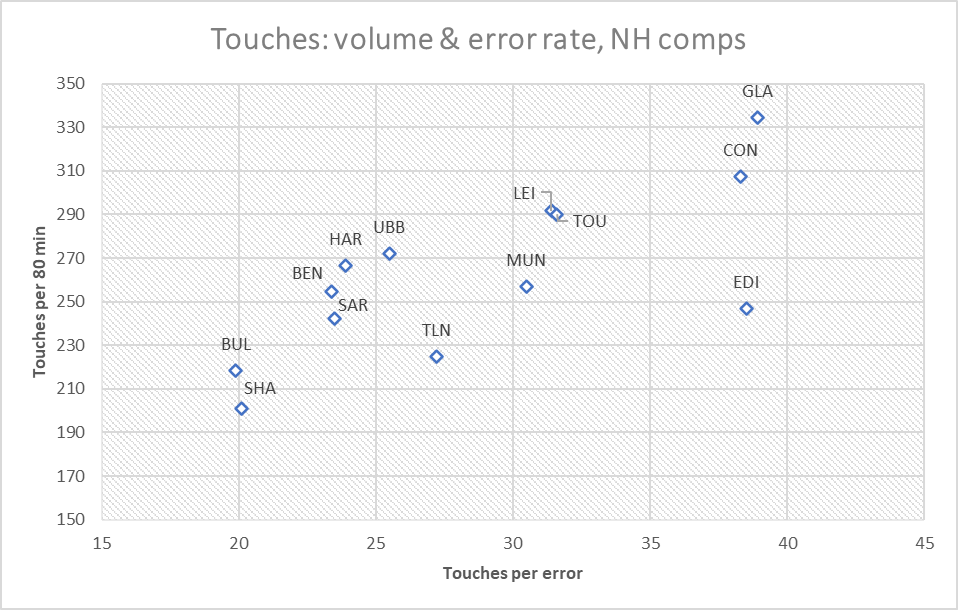
The choice of these playing philosophies is often informed by the style of play employed by the national team’s dominant feeder team. In the case of Scotland, for example, they play ball-in-hand because that is how Glasgow Warriors play. Furthermore, their skillset amplifies this choice. Glasgow currently lead the pack in Europe in terms of handling ability, their side averaging nearly 40 touches (38.9) per error. That means they can go phase after phase without making a mistake. Edinburgh, the other Scottish side, are in second place, with 38.5 touches per error. It reflects a clear alignment between the competition skillset and the national team identity.

e07fde3f-b97e-4619-a046-327cb186b530-image.png
The Test divide is reflected in the NH competitions: Scottish and Irish teams emphasize possession and a lack of errors (Glasgow, Edinburgh, Connacht, Leinster, Munster) while English, French and South African teams play riskier, more erratic rugby with less possession (UBB, Toulon, Harlequins, Saracens, Bulls, Sharks). Toulouse are the outlier here.

As a way of contrast there is France, who use the Toulouse and Bordeaux teams as their foundation for backline play. Neither of these teams are at the absolute top in terms of touches per error (8th and 28th). Instead, what stands out is that these teams rank highly, both in their offload success rate (80 and 78,8%, 5th and 8th amongst European teams), as in their % of line breaks leading to tries (52.3 and 43.9%, good for 1st and 6th). This has resulted in Galthié developing a playing philosophy where they don’t want to overplay but want to emphasize their transition attack instead, using their side’s offloading ability and efficiency in finishing clean breaks. Mistakes are fine, so long as they lead to broken field play.

Super Rugby Pacific
So we see that there is relative clear alignment between club performance and Test strategy in the NH competitions. The Bulls and Sharks are some of the most error-prone teams in the URC. So it makes sense that the Springboks don’t play a possession game, preferring instead to pressure the opposition through aerials and defence, while emphasizing opportunities in transition attack as well.

So then we get to the All Blacks and the Wallabies. Both teams average a high number of touches, similar to Scotland and Argentina. So we should expect a similar error rate as the one produced by teams like Glasgow, Edinburgh and Toulouse (Mallia, Chocobares), right?

Not quite.

5820d352-3ce2-49a7-949e-e597e22215d3-image.png
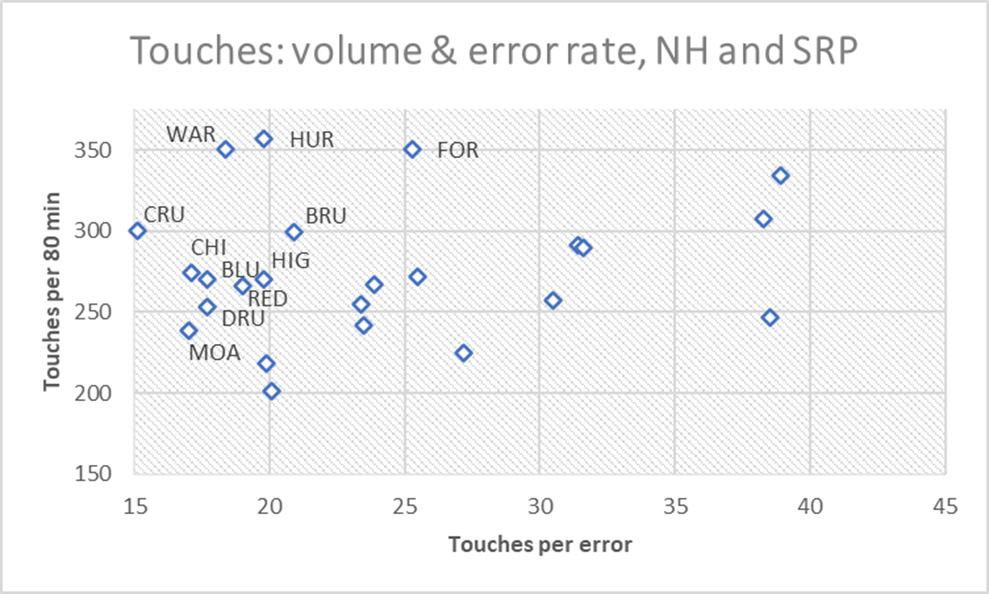
SRP teams’ rate of volume and errors: chaotic rugby has arrived

Notice how the analytical logic of NH rugby – high error rate equals low possession, low error rate equals high possession – has gone straight out of the window. Super Rugby sides have the least amount of touches per error (the Crusaders nearly get bumped off the chart) yet they still put in more touches than most other teams.

It is at this point that I feel obliged to say that this is by no means an attempt at bagging Super Rugby Pacific. It is, in my personal opinion, fantastic rugby. The point I’m simply trying to make is that using Super Rugby teams as a feeder for an international Test possession game is, to put it mildly, ill-advised. Everything in this comp points to emphasizing transition attack, not a multiphase, low error possession game.

I’m also not saying it can’t be done. Joe Schmidt nearly got NZ another World Cup having the ABs play this way; Vern Cotter got the Blues over their Super Rugby hump by keeping the ball and racking up the phases. But if you’re looking for a way to optimize your talent pipeline, where you have plenty of options and depth, then your international strategy needs to be aligned to the way your teams play. Look at what happens to the Schmidt Wallabies when they start getting injuries; there’s no one after the top group who can play the way they need to.

The Robertson sacking: an unavoidable reality
The All Blacks never looked convincing in 2025 and if we start to look a bit beneath the surface, the real surprise is how they actually managed to win as many games as they did last year. Super Rugby Pacific simply doesn’t prepare players at all to play a high possession game, as the rate of turnovers is simply way too high.

While teams in SRP with really high turnover rates (like the Crusaders) can survive and even thrive in the competition, that is because they are lethal in transition attack and finishing line breaks (they were in the top 3, alongside Toulouse and UBB, in that category last season). No such efficiency was ever reached by the ABs at Test level because the players in the team clearly weren’t singing from the same hymn sheet. And that means that either Robertson couldn’t get his selection right or he couldn’t get the players to listen. Either way, that’s damning for this coaching group and it ultimately led to Razor's undoing.

The next AB coach would be wise to look at Super Rugby and simply accept the fruits given to him: get dominant on defence and at the breakdown, and attack from anywhere.

nonpartizan

Excuse me from just jumping into the thread without having read it.

Just wanted to say, I do think Super rugby gives advantages to the ABs in some key areas. I would cite the last 20.minutes of the game in Chicago as an example. Once the Irish team tired and the game opened up they could not live with the ABs in terms of the passing and ball movement. Ireland managed no line breaks that day.

A lot of the NH teams rely so heavily on coaching/structure/kicking/defence/set pieces that when they have to play some rugby without following a script they just can't do it.

It might not be a popular opinion but I still.think that in 2026 the average professional Kiwi rugby player has more instincts and a better "feel for the game" than a lot of other nations where the players are big strong athletes but perhaps a bit robotic.

canefan

@nonpartizan said in Does Super Rugby prepare players for Test Rugby?:

Excuse me from just jumping into the thread without having read it.

Just wanted to say, I do think Super rugby gives advantages to the ABs in some key areas. I would cite the last 20.minutes of the game in Chicago as an example. Once the Irish team tired and the game opened up they could not live with the ABs in terms of the passing and ball movement. Ireland managed no line breaks that day.

A lot of the NH teams rely so heavily on coaching/structure/kicking/defence/set pieces that when they have to play some rugby without following a script they just can't do it.

It might not be a popular opinion but I still.think that in 2026 the average professional Kiwi rugby player has more instincts and a better "feel for the game" than a lot of other nations where the players are big strong athletes but perhaps a bit robotic.

I agree that our players are more instinctive. Meld that with a decent structure (as opposed to what we saw in the last 2 years) and we are deadly

If you didn't read all of @mauss below this is the last sentence.

"The next AB coach would be wise to look at Super Rugby and simply accept the fruits given to him: get dominant on defence and at the breakdown, and attack from anywhere."

I agree with his conclusion, and your comments 100%.

canefan

@mohikamo said in Does Super Rugby prepare players for Test Rugby?:

If you didn't read all of @mauss below this is the last sentence.

"The next AB coach would be wise to look at Super Rugby and simply accept the fruits given to him: get dominant on defence and at the breakdown, and attack from anywhere."

I agree with his conclusion, and your comments 100%.

Keep it simple!

said in Does Super Rugby prepare players for Test Rugby?:

If you didn't read all of @mauss below this is the last sentence.

"The next AB coach would be wise to look at Super Rugby and simply accept the fruits given to him: get dominant on defence and at the breakdown, and attack from anywhere."

I agree with his conclusion, and your comments 100%.

That was a comment on @canefan, not @mauss
Trying to keep it simple!

canefan

@mohikamo said in Does Super Rugby prepare players for Test Rugby?:

said in Does Super Rugby prepare players for Test Rugby?:

If you didn't read all of @mauss below this is the last sentence.

"The next AB coach would be wise to look at Super Rugby and simply accept the fruits given to him: get dominant on defence and at the breakdown, and attack from anywhere."

I agree with his conclusion, and your comments 100%.

That was a comment on @canefan, not @mauss
Trying to keep it simple!

I figured you were commenting on Mauss' comment and was just chiming in!

18 days later

Mauss

The speed of attack has become crucial in today’s game: this weekend’s France versus England Test was yet another great example of how the highest levels of the game are currently moving at a breakneck pace, the speed of the attack simply overwhelming the defence. England’s first score of the night nicely encapsulated this.

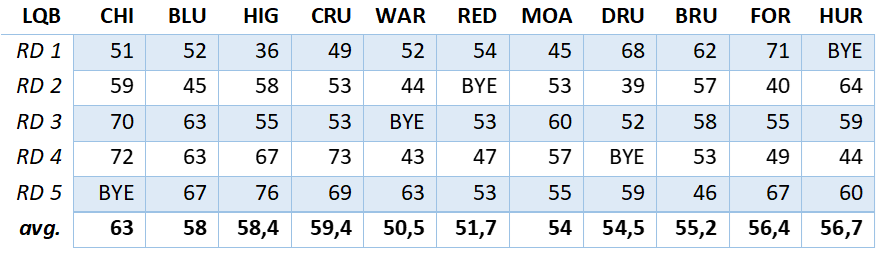
Off a Dupont box kick, England build a total of 7 rucks. Off those 7 rucks, 6 of them were lightning quick (LQB), taking 3 seconds or less for the ball to be recycled and moved away from the ruck.

Throughout the sequence, England use a relatively traditional 1-3-3-1 shape, with two groups of tight five forwards (+ Pepper) in the middle and Chessum and Earl on the edges. Three things, however, make the shape very potent: (1) the aforementioned quickness of delivery, (2) the interplay of the forwards, consistently shifting the point of attack before contact, and (3) Fin Smith’s play at the line, both attacking the defence himself as well as playing out the back.

Itoje short pass

Coles, Smith and Spencer shift the point of attack

Fin Smith outflanks the French defence
First English scoring sequence: Itoje with the short pass at the line; Coles, Smith and Spencer shifting the point of attack at the line; and finally, Fin Smith outflanking the French defence

With the French defence unable to stifle momentum through a lack of dominant hits and breakdown pressure, the English attack is able to outflank its opponent, allowing Roebuck to dot down in the corner.

It’s much the same for the second English score: from a lineout just outside the French 22, England build just 5 rucks, but each of them across the gain line and under 3 seconds. While the shape is different – both Chessum and Earl now attacking through the middle – the principles remain the same: use lightning quick ball to get behind the French defensive line and let the halfbacks (Spencer and Smith) orchestrate strikes through either hands or the boot.

Spencer grubber
The French defence is unable to keep up with the attack and miss out on Fin Smith swinging back to the blindside for Spencer's grubber

Speed was also the deciding factor for the French scores. But while the English generated momentum through building quick rucks, the French on the other hand attempt to avoid building rucks altogether, preferring instead to keep the ball alive at first or second phase, and attack the available space from the off. The first two French scores required just the one ruck in total, a crash ball from Matiu in midfield. The rest was just clean kick execution towards the space by Ramos and Jalibert, with Bielle-Biarrey on hand to finish.

Ramos kick
Ramos kick

Jalibert kick
Jalibert kick

While you could argue that this is ‘bad defence’ – similar to how Ben Smith just argued for RugbyPass – the reality is that any defensive realignment towards anticipating LBB’s line here will simply create a different space to attack for Jalibert. When you have playmakers as skilled as Jalibert and Ramos, any defensive scheme will have certain weaknesses.

SRP: lightning quick ball but mixed degrees of direction
England have led this year’s Six Nations in LQB (60% of their rucks are between 0 and 3 seconds) but their attack has only clicked against Wales and France. This is also indicative of the fact that quick ball in itself isn’t enough to create a potent attack. What you also need is direction, from halfbacks that steer the attack towards the right part of the field and are able to get the ball where the defence is at its weakest.

Fin Smith carried the ball 7 times for 27 metres against France, and while this might not seem like a massive number, his ability to take on the line had a massive effect on the French defensive line. Similarly, Dupont, Jalibert and Ramos displayed pinpoint accuracy with their boot and their decision-making, creating multiple tries for France through sheer skill execution.

Furthermore, the shape of your attack matters as well. If you have quick ball but the halfback has no real potent attacking options surrounding him, then the chances are high your attack is going nowhere.

So, with all this in mind, how does Super Rugby stack up at the moment? In terms of quick ball provided, Super Rugby is clearly of international standard, with most sides averaging 50% or more ruck speed of 3 seconds or less.

d7c60e1e-687a-450a-b844-ad16cd248ba3-image.png
Super Rugby is still a fast-paced competition (stats from RugbyPass)

This compares favourably to a competition like the Six Nations, where the sides average between 44.8 (ITA) and 60% (ENG) of lightning quick ball. A side like the Chiefs, for example, are currently averaging quicker ball than any Six Nations side, while the Highlanders’ 76% quick ball against the Crusaders in Round 5 represents the highest recorded percentage across the competitions.

But the caveats quickly appear here. Because while the Highlanders had plenty of quick ball at Apollo Projects Stadium, they had very little to show for it, with just the 18 points and 5 line breaks on the stat sheet. A comparison to the France-England game quickly makes apparent what the men from the South were lacking. While Ben Spencer and Fin Smith were bossing the English attack, putting variety into their shapes and attacking the line with intensity, the Landers halfbacks were unable to provide similar incision.

Fakatava and Millar combined for just 8 runs and 31 metres, a low number considering the amount of opportunities to attack the seams from quick ball. They were mostly content to go either vertical or lateral, hoping for opposition errors or some magic from Tangitau or Tavatavanawai. Such straightforwardness, however, is easy to defend, the Crusaders defence swallowing up an attack that is easy to read.

That represents a missed opportunity because when Millar did decide to run, it clearly spooked the Crusaders’ defence.

Millar half break
Millar half break

The Highlanders attack in the 63rd minute is a good example of why quick ball in itself doesn’t mean very much. Tavatavanawai is launched inside the Crusaders 22 off a set piece attack, and while the Landers are able to generate quick ball (< 3 seconds), at no point does the point of attack shift at the line (short passing, offload after contact). It’s just one-off runners, making it rather predictable and easy to defend. The Highlanders can’t cross the gain line and are eventually turned over by Fainga’anuku.

Highlanders attack inside 22

Fainga'anuku turnover
Quickly going nowhere: the Landers attack is unable to dent the Crusaders defence through a lack of variety

This can be contrasted to the Crusaders’ approach to quick ball and, especially, their halfbacks role in exploiting such ball. Both Hotham and Reihana tried to switch up play, attacking the line from 10 or sniping around the ruck, combining for 14 runs and 76 metres carried. Whenever Hotham sniffed an opportunity, he wouldn’t hesitate to run at the space.

Hotham run I

Hotham run II
Exploiting lightning quick ball: Hotham runs at the space around the ruck

This approach also led to different outcomes inside the opposition 22: whereas the Highlanders lack variety, the Crusaders tried to consistently shift the point of attack, attacking where the Landers defence was weakest. In the first half, from a tap penalty, Hotham passes left after a right decoy run from the forwards. Reihana attacks the line and offloads back inside to Ennor. With a quick recycle and the Landers defence in shambles, Newell can basically fall over onto the try line.

Reihana attacks the line

Similarly, in the 65th minute, with the Crusaders hot on attack off of turnover ball, Reihana is presented the ball just inside the Highlanders 22. Rather than further passing along the chain to the openside, he swings the ball back to the blind, to where an open Will Jordan is faced with a bunch of tight 5 forwards. While the try is disallowed for obstruction, it shows clear principles of how to exploit the benefits of quick ball.

Reihana shifts the point of attack

Tl;dr
While the North’s recent scoring extravaganza is considered by some to be caused by poor defence, the reality of it is, is that attacking efficiency is reaching new heights. Combining lightning quick ball with multi-skilled halfbacks is a nightmare to defend for any team, below or above the equator.

So how is Super Rugby stacking up? The competition as a whole is providing quick ball but in terms of halfback direction and attacking shape, it is more of a mixed bag. Simply producing quick ball isn’t enough: the team also needs decisive and skilled playmakers, as well as players (forwards or backs) able to shift the point of attack close to the line. While some seem to have lost their running game (Fakatava), others, like Hotham and Reihana, are growing in confidence, attacking the line and creating a complex picture for the defence to read. Further polish some of their other skills and the points will rack up in Super Rugby as well.

Duluth

@Mauss I just did a small edit to your post to make the images appear

antipodean

@Mauss excellent analysis and it agrees neatly with the eye test (which may be why it's excellent), but a rush defence is now obviously best countered by a distributing player who can make decisions at the edge of the fold. With the hard running centre at that very point it creates the decision moment for defences - and that's what develops opportunities.

antipodean

@Mauss said in Does Super Rugby prepare players for Test Rugby?:

The speed of attack has become crucial in today’s game: this weekend’s France versus England Test was yet another great example of how the highest levels of the game are currently moving at a breakneck pace, the speed of the attack simply overwhelming the defence. England’s first score of the night nicely encapsulated this.

I made the comment in the game thread that I was amazed at the ruck speed of England's last try. It was so quick France were incapable of stemming the tide - throw a player in to try and slow it down and you're short in defence because the ball has already gone. The irony being the speed meant the defence was overwhelmed as a result of France capitulating the ruck to try and defend.

Admittedly it was at the death of the game which had been remarkably fast paced for a considerable part of it, but it demonstrates that with the right referee the gameplan to move the ball matched with hard carry cleans can provide the space for skills to dominate.

Mauss

@antipodean said in Does Super Rugby prepare players for Test Rugby?:

I made the comment in the game thread that I was amazed at the ruck speed of England's last try. It was so quick France were incapable of stemming the tide - throw a player in to try and slow it down and you're short in defence because the ball has already gone. The irony being the speed meant the defence was overwhelmed as a result of France capitulating the ruck to try and defend.

England consistently shifting the point of attack at the line, via forwards passing short or Spencer using an array of (well-executed) attacking kicks, also played a considerable role in this, I think. If you don't know where the ruck is going to be formed, it's very hard to attack the breakdown on the front foot.

It's the fascinating thing about Test rugby right now. You need to be clear as a collective before the game has even started on whether you're going to go all-in on attacking the breakdown or whether you're going to go for defensive numbers in the line. Ireland were always going to attack the Scottish breakdown because they wanted to frustrate their attacking momentum. France-England would've been a totally different game if France had decided to really go after English quick ball. Their inability to anticipate the English plan nearly cost them the title.

Knowing what to emphasize during the week is what makes a great international head coach (which Andy Farrell has proven to be, once again). It's very small margins at the top nowadays.

MiketheSnow

I’ll summarise it further,

Kick like shit, eat shit

1 month later

Mauss

Graham Henry's verdict on Super Rugby Pacific
Graham Henry recently made the point in an interview with Martin Devlin that Super Rugby doesn’t prepare for international rugby because, amongst other reasons, there are simply not enough development opportunities for young players. With just 5 NZ SRP teams and most of the top All Blacks playing at home, there are neither enough games nor places for young players to get any sort of significant game time.

As a result, you have players reaching the highest levels who have barely figured at the immediate level below. Wallace Sititi had played just 680 minutes of Super Rugby (13 appearances but less than 9 full games in terms of minutes) before getting capped, George Bell 727 minutes, Pasilio Tosi 791 minutes, Noah Hotham 851 minutes. Kyle Preston had just played 469 minutes of Super Rugby before appearing against the Springboks at Eden Park.

Later in the interview Devlin tried to go against Ted’s argument for the importance of player rotation by saying that “we shouldn’t hand out All Blacks jerseys”. But looking at these numbers of playing minutes, that’s exactly what’s been happening, and this for more than a few years now.

In order to get a fuller sense of Henry’s argument, I’ve looked at the age profile of Super Rugby teams, comparing them to their counterparts in Europe (Champions Cup) and Japan (JRLO). I’ve also tried to map out what opportunities are available to young players, tracing the playing minutes of U21 players across these teams (all stats used are from all.rugby).

What becomes apparent is that, from a development perspective, there are some serious structural issues within the NZ rugby pyramid which are clearly impacting the ability of the national team to perform to the best of its abilities. I’ll conclude by briefly reflecting on the South African case, arguing that for Henry’s vision to work the NZR would have to go even beyond what SARU are currently doing. Whether that's realistic I'll leave to others more in the know.

Matchday squads age profile: Super Rugby Pacific compared to Europe and Japan
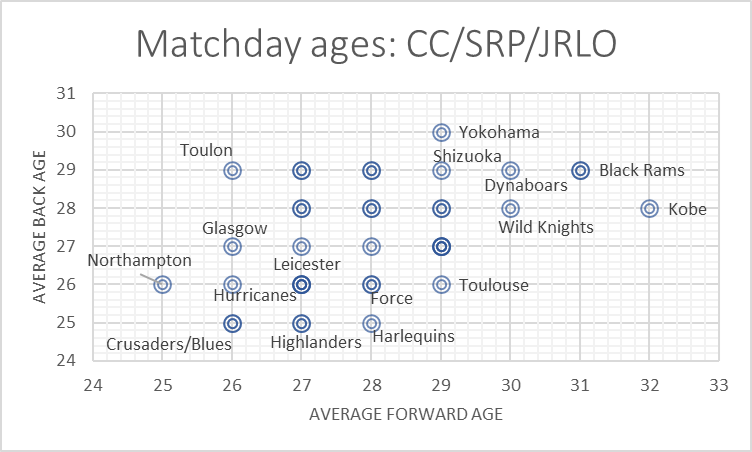
What kind of competition is Super Rugby Pacific in terms of age profile? In order to get a better sense of this, we can compare the different SRP matchday squads (Round 9) with their counterparts in Europe and Japan, looking at the average ages of forwards and backs from the Round of 16 of the Champions Cup and Round 14 of the JRLO. What quickly becomes apparent is that SRP is by no means an old man’s competition.
9529ee5f-c924-428b-a840-0c2190db21d7-image.png
The average of forwards and backs in matchday squads across SRP, the Champions Cup and the JRLO

While there is a lot of variation within competitions like the Top 14 and the Premiership – Toulouse having an experienced forward pack and a youthful backline, with Toulon having the opposite for their clash with the Stormers – the Japanese and Super Rugby competitions are on clear opposite ends of the spectrum. The SRP sides consistently have some of the youngest matchday squads whereas in Japan the teams have a lot more experienced heads running around. Interestingly, Dave Rennie’s Kobe had the oldest average age of all the matchday squads, his forwards being around 32 years old while his backs averaged out at 28.

By contrast, the Blues, Crusaders (SRP) and Northampton Saints had the youngest matchday squads, Northampton picking a very youthful forward pack for their game against Castres while the Crusaders and the Blues picked youth in the backline. Looking at the competitions as a whole, this pattern is re-established, especially for Kiwi SRP sides.

43dbe65a-4626-4565-889f-ab3d40507bc3-image.png
The competitions compared on the basis of the average age of a matchday squad

Again, the same picture appears: the Japanese league is by far the oldest on average while the NZ teams are typically the youngest, both in the pack and amongst the backline. When looking at the NZ SRP teams, it does become more obvious that SRP is essentially a development competition, where players play in their mid-twenties before either becoming capped All Blacks or moving away overseas.

This is an issue, especially for the forwards, as the prime ages for these players are around 28 or 29. When looking at the graph above, it seems as though the Top 14 is getting that balance right in the Champions Cup, with an average age for their forward packs just above 28 years old. While teams like the Blues and Crusaders will be able to put up more experienced packs come the playoff rounds, it does show a lack of depth in experience across those sides.

Still, as I will show below, this does not mean that SRP provides plenty of playing opportunities for young players. Rather, it shows the vision of a competition which has an incredibly tight window of high performance – between the ages of 22 and 27 – after which a definitive selection is made on which players will remain in the competition (ABs) and who will move overseas. Players who take a bit longer to reach their peak or who require different environments to get to the top of their game – think Jamison Gibson-Park – will most likely end up playing Test rugby elsewhere. Looking at the struggles with halfback depth behind Roigard (Hotham, Ratima, Fakatava, Preston), this is far from an ideal situation.

U21 minutes across competitions
Before I can get to the actual numbers of U21 minutes played, some remarks are first in order. First, why focus on U21s? I believe the years between 18 and 21 are a crucial period of player development, with the first steps of professionalism being undertaken. Yet this period, ironically enough, often goes paired with a distinct lack of consistent rugby, with players bouncing around between all kinds of playing environments (U19s, U20s, club rugby, provincial rugby, national rugby, and so on) without getting the opportunity to settle for a longer period of time.

And this brings me to a second point: the way different competitions engage with their U21 players varies greatly. In Europe, you have big Top 14 and Premiership academies, where players play and compete alongside each other for a number of years. While this can be a lonely and alienating experience for players in its own right, what it does provide is consistency. In Super Rugby Pacific, you can get a development contract or you can be selected in the main squad outright. The academy system is mostly associated with the NPC sides yet it seems unlikely to me (although feel free to correct this) that these teams have the proper facilities available to organize continuous development for those players who fall outside of these SRP contracts.

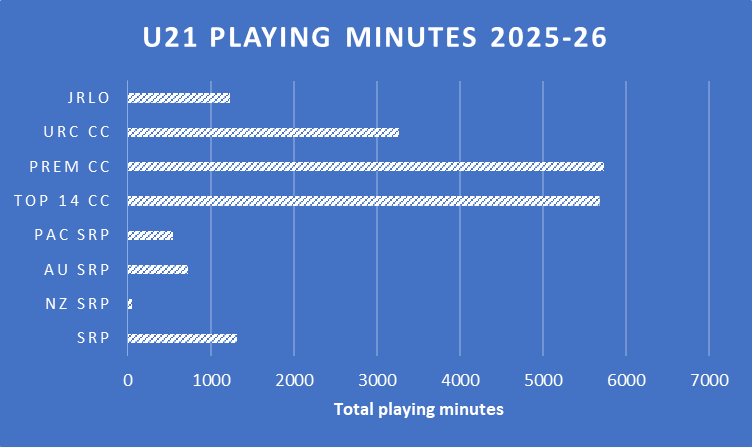
With this in mind, we can look at the total playing minutes of U21s (i.e. being born on January 1st 2005 or later) across these competitions from this current season. Despite just having the data for 4 Top 14 and 7 Premiership teams (in comparison to 11 SRP and 12 JRLO teams), these two comps stand out substantially in terms of afforded playing minutes to U21 players.
7042adbd-4436-49de-a529-acd625ca9d3c-image.png
The 7 Prem teams (Northampton, Bath, Saracens, Bristol, Harlequins, Sale and Leicester) and 4 Top 14 teams (Toulon, Toulouse, Castres, Bordeaux) have a massive advantage on their competitors (data last checked on the 16th of April ’26)

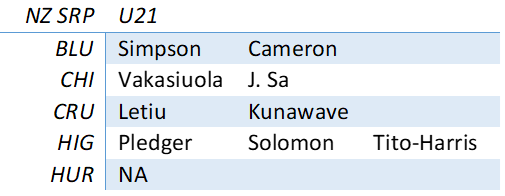
So what exactly is going on here? There are currently 9 U21 players contracted to NZ SRP teams (see table below). Of those, only Manumaua Letiu has received any playing minutes so far this season (51’ in total), with Tito-Harris joining him in Round 10 after his debut for the Highlanders off the bench at Eden Park. These numbers might’ve been different if Pledger hadn’t gotten injured in preseason but it’s still quite a small number of players regardless, with the Hurricanes having no one from ’05, their youngest current player contracted being Vernon Bason (’04 birth).
284a6cf2-1aa5-4f76-be3c-944c4d6c0c55-image.png
The NZ U21 players contracted to SRP teams

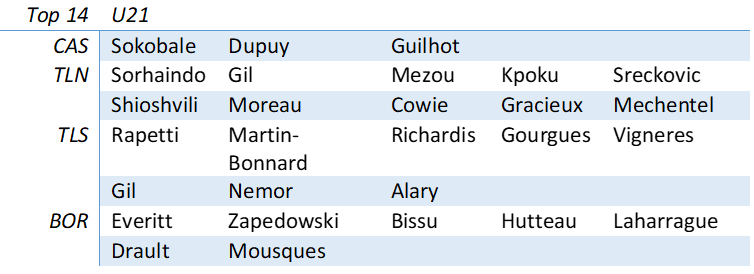
The gap in playing opportunities becomes really visible when we compare this playing group to the U21 players already used this season by the 4 French R16 Champions Cup teams.
3a39d96e-5648-4021-8bed-7c0f9a97255b-image.png
The 28 U21 players who have received gametime for 4 Top 14 clubs this season

These players are different from their Kiwi counterparts in that they are typically not contracted to the senior side but are part of the academy. What they do receive, however, is game time: all of these players have played either Top 14 or Champions Cup, the highest levels you can reach below Test level.

Of course, not all of these players are the same: someone like Colin Dupuy (CAS) has only played 4 senior minutes this season, whereas Kalvin Gourgues (TLS) has become a regular in the Toulouse midfield (1212 minutes). Similarly, what is noticeable is how many different nationalities appear in the French youth system: there are South Africans (Everitt), Englishmen (Kpoku) and Georgians (Shioshvili) but also Polish players (Zapedowski) and those who represent Spain at international level (Richardis). It’s the globalizing rugby market at work.

The reason why so many Top 14 U21s get playing minutes is twofold: it is due to the immense investments being put into the academies and it is further made possible by the sheer amounts of games available. With a maximum of 29 possible games in the Top 14, as well as another potential 12 Champions Cup matches, certain Top 14 teams play 35+ games per season which necessitates rotation and massive available squads. Teams like Toulouse, Bordeaux, Northampton and Leinster all have excellent academies which allows them to bring through game-ready youngsters, giving the next generation game time while still holding onto some of the biggest names in the sport.

The SA case: so has Rassie got it right?
Throughout his interview with Devlin, Graham Henry waxed lyrical about SARU’s current approach to things, referring to the depth, playing opportunities and team culture created by Rassie Erasmus. By allowing wealthy overseas clubs to pay for the best Springboks, so Ted opined, the way is being paved for the next generation to come through.

But while it’s tempting to view the Springbok Test results as a direct reflection of the South African rugby pyramid, the reality is slightly more complex than that. The South African case is quite unique and shows some of the challenges that come even with a higher number of playing opportunities available.

1. Young players still have their pathway blocked
While the South African teams are giving their U21 players more game time compared to the NZ SRP teams, this discrepancy still isn’t as high as it probably should be. For example, despite the fact that the South African teams can play up to 10 more games per season than they did in Super Rugby – the Bulls played 27 games during the 2024-25 season, compared to a maximum of 17 SR games that season – their U21 minutes still lag considerably behind the Top 14.

1a761daa-a945-4425-b128-653a8b16e1cd-image.png
The four SA teams (Bulls, Lions, Sharks, Stormers) compared to the four Top 14 Champions Cup teams (R16)

And this is despite the fact that multiple U20 World Cup winners are entering into the professional domain, such as Pead, Hlekani, Jooste, Mlaba and Jaco Williams. As South Africa only really has 4 professional rugby teams (plus the semi-pro Cheetahs), there are a huge number of professional journeymen available within South African professional rugby, who are taking up places for more promising young rugby players.

The international rugby market is largely saturated, also due the availability of the top Springboks, who are of course preferred in Japanese rugby. Graham Henry’s ideal of the top ABs being paid for has, then, an unintended side-effect: those fringe SRP players who weren’t good enough for the ABs will most likely lose their contracts and return to Super Rugby Pacific. So if the competition isn’t expanded with more Kiwi teams, those U21 players will still not get any more opportunities than they currently have.

2. Overseas development opportunities are becoming blocked
Henry’s vision of the All Blacks also included them actually developing as rugby players abroad, learning from top clubs on how to become better players and perform on the highest stage. Erasmus undoubtedly had a similar idea yet hit a snag due to these Boks underperforming abroad. Jon Cardinelli, the SA journalist, released a graph last year which clearly showed that certain competitions like the Premiership and the Top 14 had lost their appetite for Springboks, as they couldn’t (or wouldn’t) replicate their Test form for their club teams.

0ed7d36c-5dcf-45bb-be2b-f6d686fe6e2a-image.png
Fewer and fewer Springboks are playing in competitions such as the Premiership and Top 14, with the majority of them playing in Japan (source: Jon Cardinelli: https://www.rugbypass.com/plus/how-the-springboks-are-looking-east-for-a-world-cup-three-peat/)

A player like Pieter-Steph Du Toit is a good example of why paying for the top Springboks is a poisoned chalice for club teams. Since the 2023 Rugby World Cup, Du Toit has played 19 out of 27 Bok Tests (70%), mostly going for the full 80. In that same time period, however, PSDT has played in just 14 club games for Toyota Verblitz, out of a possible 48 (29%).

It seems likely then that his next contract will, once again, be in South Africa, just as it was for Etzebeth, Kolisi, Reinach and Pollard. Thomas Du Toit, arguably the best tighthead in the world right now, is also moving back to South Africa after this season. In an inverse move, Ruan Nortjé, the Bulls lock, is going to Japan at the end of the season, in a move rumoured to be engineered by Rassie in order to make sure his locks are rested enough for the 2027 Rugby World Cup.

So what we are seeing in South Africa is by no means the workings of the free market but something that is carefully being orchestrated by Erasmus. If his idea was to let other cash-rich clubs pay for his top Springboks, it seems fair to say that it hasn’t quite worked out like that.

A different path
So if NZR were to follow in the footsteps of SARU and allow their top ABs to play overseas, they would do well to see how the South African system is far from functioning perfectly. The new generation isn’t coming through effortlessly at professional level and overseas clubs are becoming more and more hesitant in signing expensive Boks. If the ABs were to go in the same direction, these clubs will make sure to communicate their expectations, which is that the club comes first.

And if Graham Henry’s view of the future were to be successful, it will most likely depend on NZR’s ability to create more playing opportunities for young players at the highest levels, expanding both the numbers of teams as well as the number of high-level tournaments these teams participate in. A massive investment in academy systems will also be necessary, if they want these players to be ready for game time when they do eventually get their opportunities in these tournaments.

That all sounds like a massive amount of money needing to be spent. And looking at NZ Rugby’s recent financial policies as well as their inability to get reforms across the bridge, it also sounds like an incredibly unlikely turn of events. The only thing we can hope for is that the current administration has some more nous than the former. At least that shouldn't be so hard.

Tl;dr
Graham Henry’s argument for Super Rugby’s inability to prepare players for Test rugby is built around the lack of playing opportunities available to young players. Analysis of SRP age profiles shows two things: (1) SRP has an incredibly tight high-performance window (22-27) after which a huge number of players leave the competition. And (2) due to a lack of an aligned academy system, SRP teams give essentially no playing time to U21s, this despite the fact that these are key years for professional development.

While Henry points to South Africa’s overseas selection policy as an example to follow, their unique situation has shown its own limitations (limited U21 minutes, diminishing opportunities for top Springboks overseas). It might be worth exploring how a French-style development system (more teams + high investment in academies) could be implemented within the structures of Super Rugby Pacific. While this would require serious funding (as well as dissolving the NPC as a professional competition), without such an investment it is difficult to see how NZR would keep up the pace alongside the rest of the rugby world.

As a warning, I’d recommend watching Squidge Rugby’s latest video on how the situation in Wales has unravelled. Not investing in your own future pretty much equals giving up on it.


@Mauss That's a really interesting read mate, thanks.