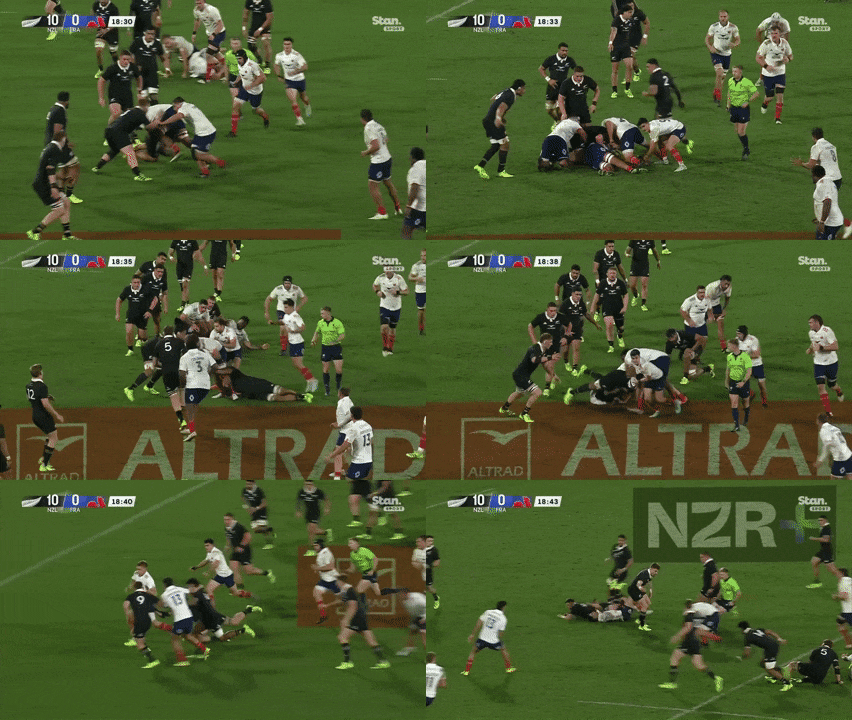
I thought it would be interesting to take a closer look at the performances of the four AB props on Saturday, seeing how the top 2 AB props (Williams and Lomax) are currently unavailable and the 4 props of the 2nd French Test (de Groot, Newell, Norris and Tosi) all got considerable minutes on the field. Focusing solely on them for the 80 minutes, I ended up with some observations, one part focusing on their collective numerical output, the other on facets which don’t really show up in (public) stats.
Some numbers
Sifting through the footage, I eventually came up with these numbers (Sidenote: some numbers will differ from the publicly available stats like those provided by RugbyPass, due to, I assume, different interpretations of what constitutes a completed and missed tackle).
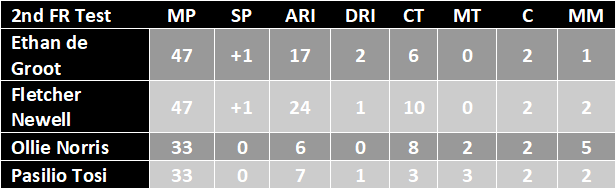
Abbreviations:
MP: minutes played
SP: scrum penalties
ARI: attacking ruck involvements
DRI: defensive ruck involvements
CT: completed tackles
MT: missed tackles
C : carries
MM: metres made
While numbers very rarely tell the whole story, much less from such a limited data set, I think there’s a surprising amount that can be gleaned from this particular table. What stands out like a sore thumb is the breakdown work of the starting props compared to the bench props. While Newell and de Groot (to a somewhat lesser extent) were omnipresent at the attacking breakdown, moving bodies and ensuring clean ball, the bench props were much less present there.
This was, when looking at the game, clearly by design. Norris and Tosi often took up positions in the first pod outside the breakdown, ready to carry and use their big frames to bend the French line. But this is the rugby equivalent of counting your chickens before they hatch. Because what happened on the field was that, suddenly, backs like Barrett and McKenzie were needed to clean ball in the middle of the field, with rather predictable results.
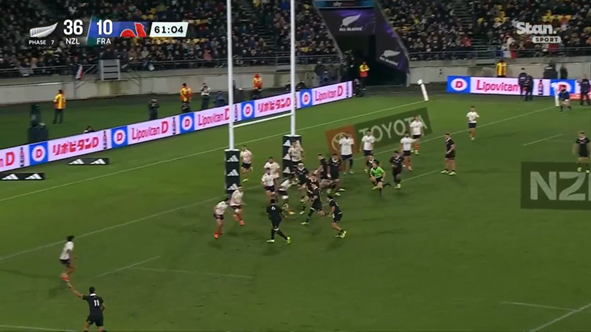
Norris looking rather sheepish while the play switches in the other direction
In the picture above, for example, we can see Norris standing on the right side of the goalposts, ready for a carry close to the line. But instead, Roigard switches the play back to the open, similar to the switch play for the Jordan-try in Dunedin. But with both props playing relatively far away from the source, it’s now up to Beauden Barrett and Will Jordan to clean after the Vaa’i carry.

An ugly breakdown, which is more the norm than the exception when you have a 10 and 15 cleaning out a hooker like Bourgarit
While the sequence eventually ends with a try to Rieko Ioane in the corner, it’s clear how the composition of the bench, together with the gameplan of ball-carrying bench front-rowers, caused havoc for the AB attacking ruck. This havoc was further compounded by Codie Taylor leaving the field, who was, quite literally, everywhere during the first half. And while Taukei’aho did his best to carry a similar load, he simply does not have the engine of a Taylor.
In the end, the gameplan bore very little fruit, Norris’ and Tosi’s combined 4 carries for a total of 7 metres made barely a fundamental upgrade on de Groot’s and Newell’s combined 4 carries for 3 metres made. Norris put in a big shift on defence but the argument can be made that this defensive shift wouldn’t be necessary if the quality of the breakdown, maul and lineout hadn’t plummeted with the bench forwards coming on. If the bench plan is to bring carrying impact then the coaches need to make sure that there are enough forwards on the field who focus on securing the breakdown. Because any plan that results in your backs having to consistently provide clean ball is a plan destined to fail.
Beyond the numbers
Fletcher Newell is an excellent Test tighthead. He combines set-piece solidity with a frankly staggering work-rate. While Newell’s and de Groot’s attacking ruck involvements don’t look too dissimilar on paper (24 and 17 respectively), the nature and quality of these involvements does differ considerably. Whereas Newell is often the first arriving player at the breakdown, responsible for the actual shifting of bodies, many of de Groot’s ruck attendances were what you’d call secondary involvements, where the breakdown has already been secured and the secondary player arrives to provide further strength in numbers.
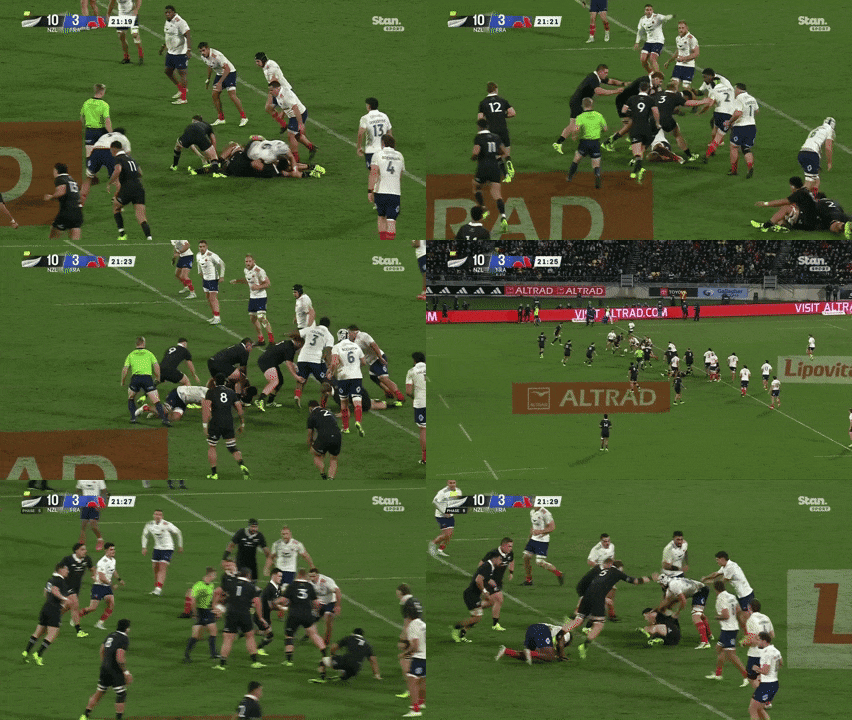
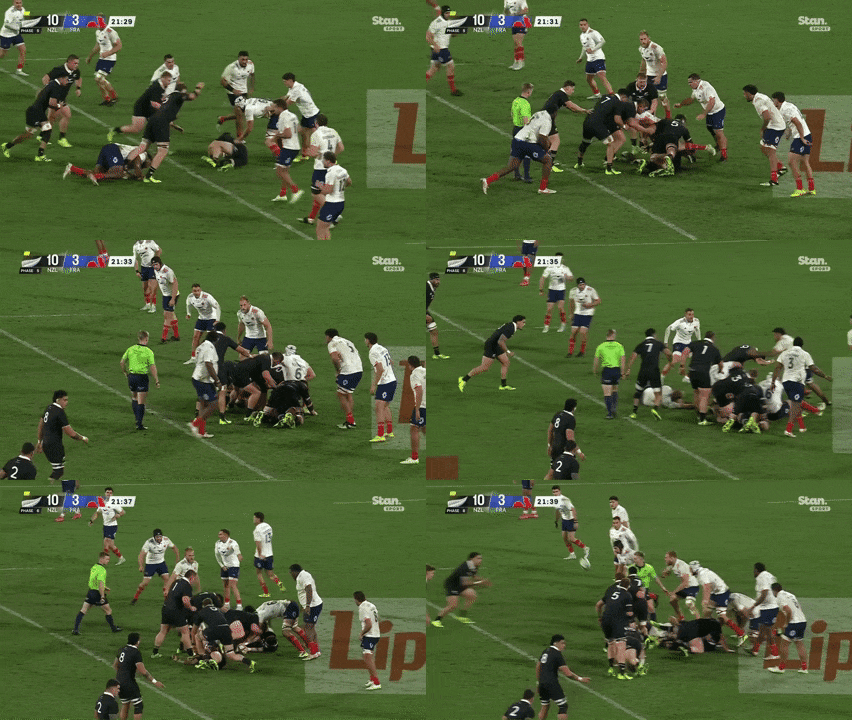
I don’t want to be too harsh on de Groot, as he put in a more than solid shift around the field and in the set-piece. But when put next to Newell, it is noticeable that he doesn’t quite offer the same work-rate. In the following sequence during the 22nd minute, for example, where the ABs are trying to go through the middle of the French forward pack, the difference between de Groot’s and Newell’s appetite for repeat efforts is stark:
In this particular series of rucks, Newell physically shifts three French players, going to the floor and getting up again. De Groot, meanwhile, is mostly ruck-watching, securing the attacking ruck while mostly leaving the actual physical shifting of bodies to others.
In de Groot’s case, it might still be an issue of fitness. While he started the Test very well, being active and physical at the breakdown, as the first half wore on it did start to look as if he was starting to struggle with the pace of the game. In the 19th minute, with the French attacking in the NZ half, de Groot was slow to fold back to the openside, leaving a gap in the defensive line which was all too eagerly exploited by the French backs.
de Groot, jogging along in the background, is consistently behind the play
Taylor is already pushing de Groot to fold and take up the spot as a pillar defender but he’s slow to take up his position, forcing Holland to stay near the ruck. The latter is then unable to cover the ensuing gap between himself and Jordie Barrett, the French line-break eventually resulting in the yellow card for Beauden Barrett.
While I don’t think de Groot’s spot is immediately in danger – he still provides a lot more stability in the set-piece than someone like Norris – what the Chiefs’ loosehead does offer is superior fitness and mobility in the defensive line. If the latter is able to prove his reliability at scrum- and maul-time, then there might be some nervy times ahead for Gore’s finest.
Tl;dr: while the propping stocks are looking decent – Newell especially coming of age as a Test tighthead – there are still some teething issues with the gameplan and how they’re used off the bench, resulting in chaos at the AB attacking breakdown. Also, while de Groot still has an edge on Norris at the set-piece, the latter’s superior fitness does present a selection threat to the former.