I’ve watched the NZ U20s game against the Junior Wallabies a few times now. I think it’s likely that in most other instances, the Junior Wallabies would win that game: they played 65% of the match in NZ territory, they made 13 line breaks to NZ’s 7, and had 15 entries into the NZ 22 compared to just 8 visits to the Junior Wallabies 22.
Then again, you can also say that the Junior Wallabies managed the game poorly, overplaying against what turned out to be a reasonably robust NZ defence. They kicked just 18 times compared to the 30 kicks from the Baby Blacks, leaving themselves vulnerable to NZ counter-attacks especially when down to 13 men. They’ll be better for the experience. If they can get some reinforcements back for the World Championship, I’d still consider them as one of the main title contenders for that tournament.
So what about the NZ U20s? I honestly can’t really say right now. They were really poor during the first half but showed some glimpses early in the 2nd half. It’s still up in the air, I think, what kind of side they’ll eventually become in 2026. Below are some thoughts that I have, based on this game as well as the upcoming match against Argentina U20.
Looking back: tight five work rate
Before the game I called the NZ U20 tight five workmanlike. It wasn’t meant as a compliment but after this game, perhaps it should’ve been. Both the starters and the replacements put in a lot of effort, both around the field and in the set piece.
Around the field, a special mention should go to Canterbury hooker Josh Findlay. Not only did I count him making 25 tackles (RugbyPass has him at 23 and the match centre stats at springbok.rugby has him making 26), he was also ever present at the attacking breakdown. From my recorded stats, he cleaned 23 attacking rucks while also completing two turnovers at the defensive breakdown, which are some really solid numbers.
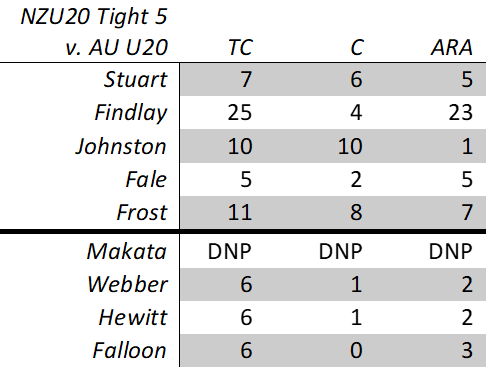
Tackles completed, carries and attacking rucks attended by the starting NZ U20 tight five and their bench replacements
The work of the tight five wasn’t limited to defence and the breakdown. Their set piece work was also very solid throughout the game. While the lineout creaked at times – one overthrow and one near steal knocked on by Australia’s Langi – they retained possession from all of their 12 throws, with Max Fale (4 takes), Jake Frost (3 takes), and Finn McLeod (3 takes) all being flawless in the take and transfer. The cohesion-factor is pretty clear: all players, both the thrower and the lineout recipients, play together for Canterbury U19s and Crusaders U20s. In matters of set piece, cohesion can definitely be an added benefit.

Lineout win percentage, lineout steals vs. lost, scrum win percentage, scrum penalties won vs. lost
The scrum wasn’t dominant by any means but similar to the lineout, they retained possession on 100% of their feeds. Even the scrum penalties were in the NZ U20s favour at 2 to 1, although some of the referee calls were a bit peculiar to say the least.
So the tight five is workmanlike indeed, but, on the basis of the previous game, that should be considered a glowing endorsement.
Looking forward: back line X-factor required
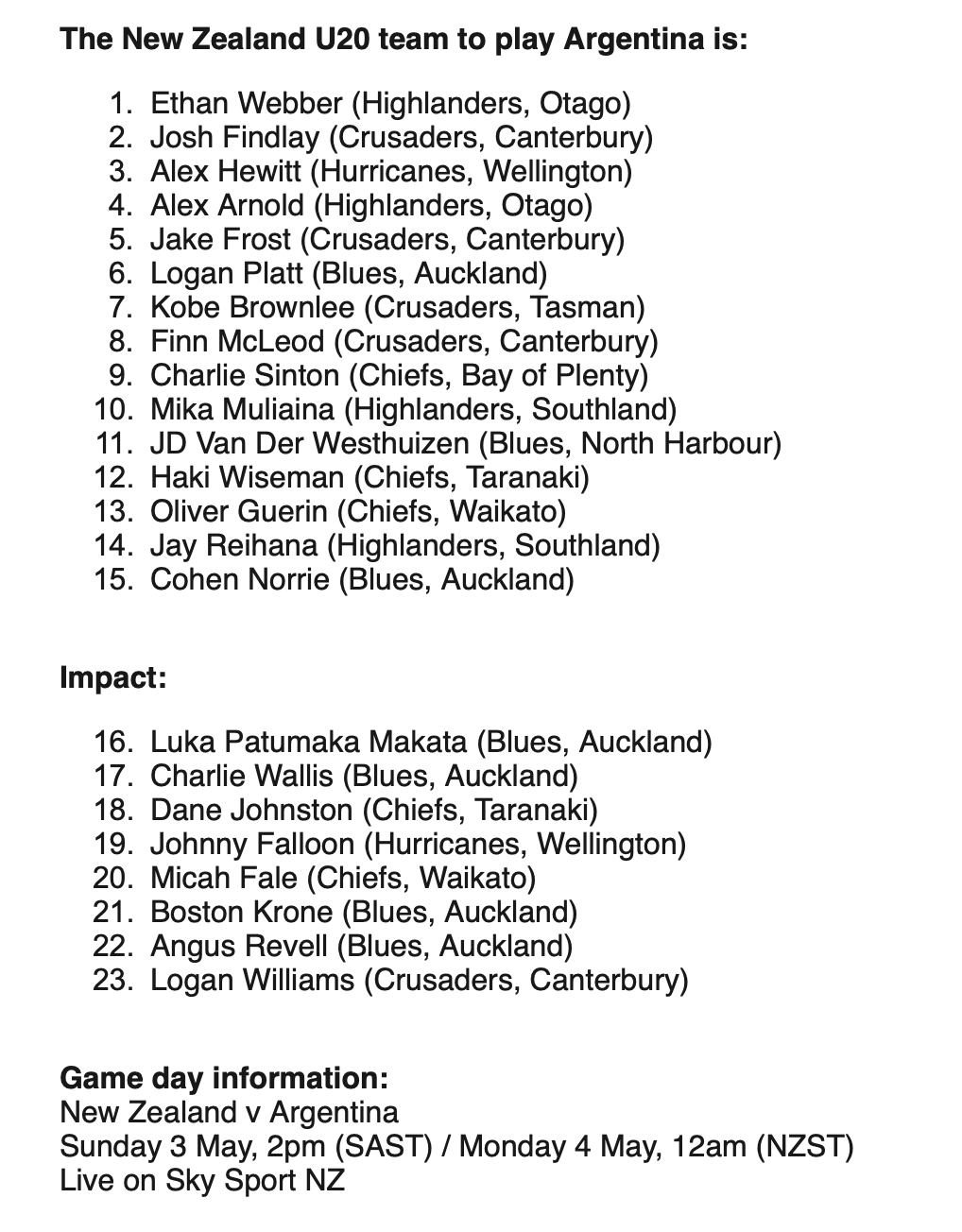
Kane Jury has brought forth some changes for the Pumitas game and those changes do make sense. The NZ U20 attack was pretty toothless and one of the reasons for this has to do with what kind of first five Mika Muliaina is.
Muliaina is a pivot in the true sense of the word: he likes the ball in his hands, often and as briefly as possible. What he excels at is creating space for his outsides, giving them the opportunity to break the line. It’s why he’s such a natural combination with Norrie at 15: whereas Muliaina likes to give space to others, Norrie wants to attack this space, using footwork and deception to beat opposition defenders. The results were obvious to see.


Norrie is an excellent attacker from second receiver, running at pace with the ball in his two hands before putting on the footwork. Both times it is Muliaina with the final pass
The problem against the Junior Wallabies was that there were too few X-factor backs for Muliaina to put into space. Both Pahulu and Guerin are more natural centres than wingers: they tend to cut back inside, looking to find gaps between defenders or connect with others, rather than use the space to beat their opposite man. With Guerin in the midfield and Van Der Westhuizen and Reihana on the wings against Argentina, Muliaina might be more effective in further unlocking the NZ U20 attack.
Looking back and forward: improved defence from U18 to U20 level
Speaking of Jay Reihana, his cameo off the bench was, I felt, symbolic of the biggest improvement shown by this group, coming from U18 rep rugby. While the desire to defend has always been there, even during those disastrous U18 encounters from 2025, what was often lacking was defensive insight. When and where to jump out, how to switch between defensive markers, how to stay connected in an aggressive pattern.
With the Junior Wallabies looking for a late winning score, Reihana showed multiple times within the space of a minute that the players had done their homework. Using their typical flat three man shape, with Mackay pulling the strings, Reihana identified the designated receiver correctly twice, smashing the Junior Wallabies ball-and-man behind the gain line.
In the first instance, Reihana correctly spots the pullback-option, jumping past the decoy and cutting down Fenwicke before he can release his outsides. In the second instance, less than a minute later, Reihana anticipates Mackay going flat, smoking Robinson as he gets the ball and forcing the turnover.


The defence can get on top of the attack by getting a read on the opposition first five’s decision making. In both instances, Reihana correctly reads the Junior Wallaby attack, effectively ending their chance for a late win
So where does that leave this year’s team for the rest of the U20 TRC and the upcoming World Championships? While I still don’t think this is a particularly vintage cohort, they do show signs of solid coaching and a resilient team culture, working hard with and without the ball. When the cupboard of talent isn’t perhaps as full as you’d like, the only thing you can really ask for is a team giving it their all. And so far at least, those signs are looking positive.