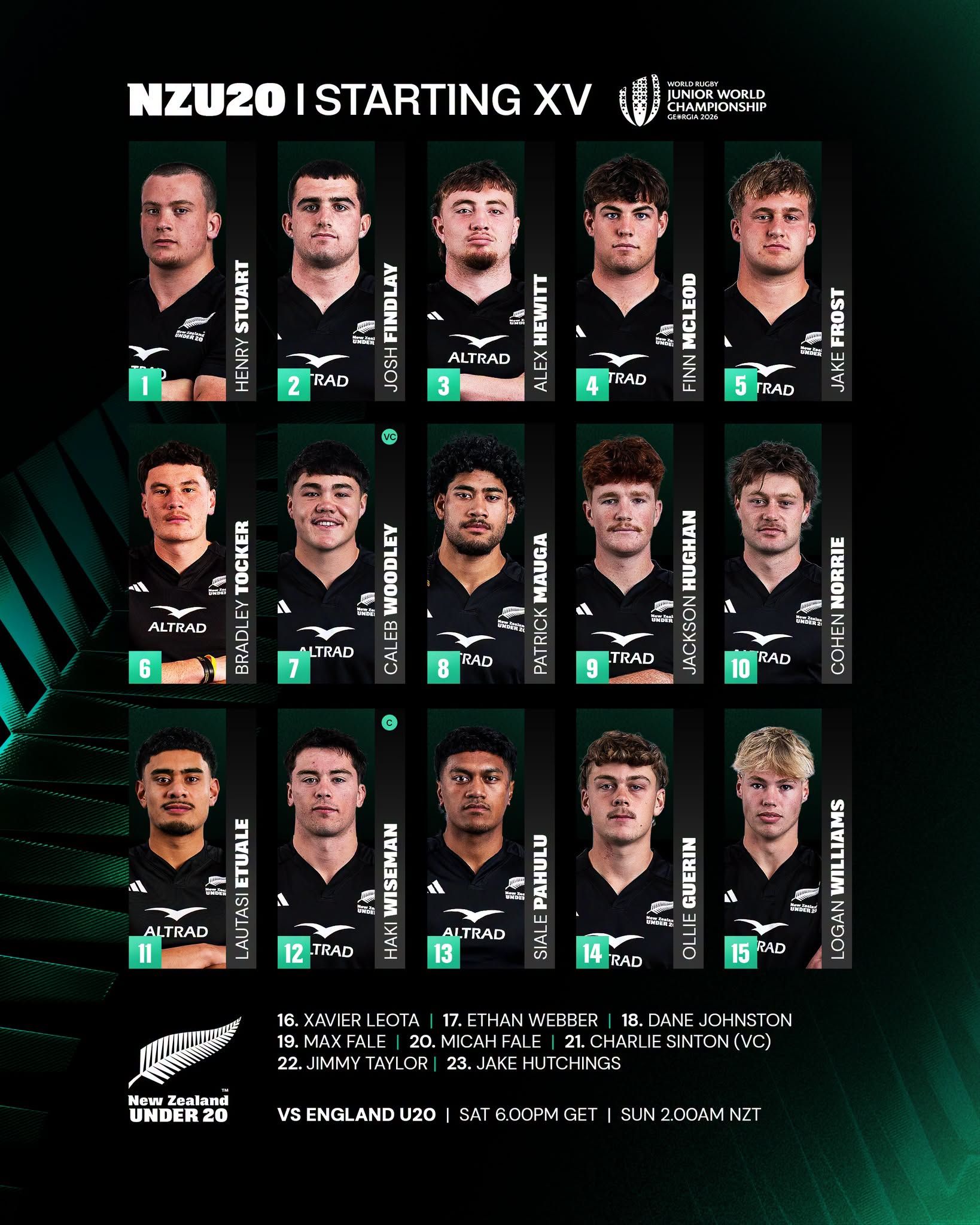
Bit late to the discussion but I tend to agree with the general feeling in the thread, which is that the team definitely exceeded expectations. I don’t think there were a lot of really polished performances – the games against Italy and England probably come closest in this particular tournament – but the work rate and belief of the group can’t be faulted. Third place is, in this sense, a very good result.
Normally I follow this tournament quite closely but I’ve spent the past few weeks on holiday, trying to limit my time spent on rugby. But since I’ve been back, I’ve enjoyed watching the games again and going through some numbers, trying to identify what this group did well (and not so well). Some final reflections on what has been an interesting group.
Stats are from World Rugby’s site, RugbyPass, and rugby.com.au:
world.rugby/u20/en/stats/2026/teams
View embedded content
View embedded content
The key to improvement: fixing the defence
One of the main reasons why I wasn’t particularly hopeful for this edition of the tournament was because of the defensive performances of these players at U18 level. Both in 2024 and 2025, the NZ Schools’ and Barbarian U18s leaked points against their Australian counterparts. The reason why this was so alarming was due to the nature of those defensive performances, which weren’t merely down to systems issues but down to effort as well.
Several of the players who were on the receiving end of 81 points put on them by the Australian U18s late last year were selected for this year’s NZ U20s as well, the likes of Siale Pahulu, Henry Stuart, and Lautasi Etuale not exactly covering themselves in glory during those games.
But when comparing the defensive metrics for the ’24 and ’25 NZ Schools team and this year’s NZ U20 side across the U20 TRC and World Championship, it becomes clear how much the defensive desire has improved. In terms of line breaks conceded, (NZ) defenders being beaten, and points conceded, the NZ U20s have been able to cut down their opposition’s attacking output by nearly 50%.
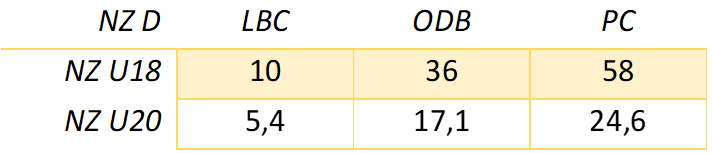
Line breaks, opposition defenders beaten and points conceded: across the 8 U20 games this season, the NZ U20s have been able to completely reverse their defensive performances from U18 level
I believe that it is this area which has acted as a fulcrum for the U20s much-improved performances in comparison to their U18 showings against Australia. It is, however, important to note that this improvement isn’t merely relative to their own (poor) performances at U18 level. The NZ U20 defence improved as the season progressed as well, becoming a clear top 3 defence at the U20 World Championship alongside South Africa and France.
In terms of the key defensive metrics – line breaks conceded, missed tackles, points conceded, and tackle percentage – the NZ U20s never leave the top 3, performing well in each category and topping the category of the opposition beating defenders (i.e. missed tackles). With just an average of 12 missed tackles per game at the World Cup (markedly improving from their average of 25.3 at the U20 TRC), the NZ U20s gave their opposition few opportunities to break their line and gain attacking momentum. Their average of 22.8 points conceded was second best in the tournament alongside France, only trailing South Africa (17.4 points conceded) who returned to their traditional strengths of defence and set piece dominance to win this tournament.
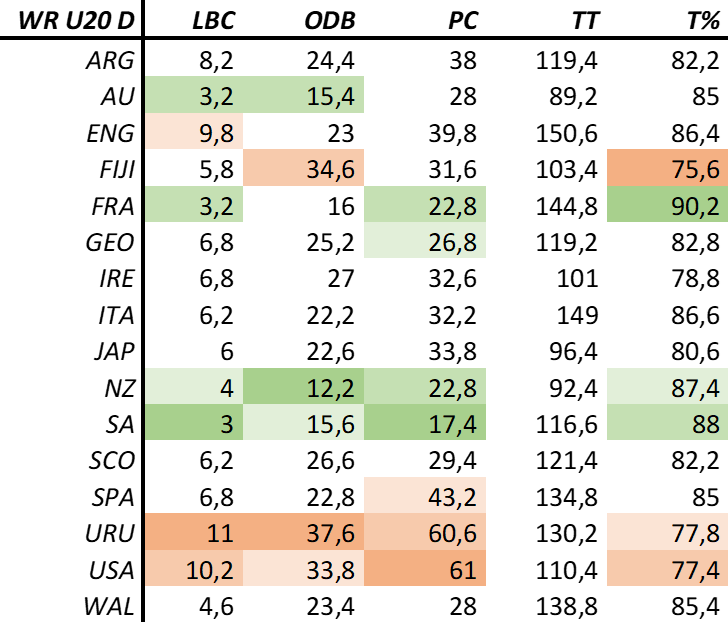
The least missed tackles and top 3 in line breaks conceded, points conceded and tackle percentage: the NZ coaches clearly made defensive solidity a priority for this group, unsurprisingly perhaps after results at U18 level
When looking at the total number of tackles made by each team in the 4th column, it’s clear that the NZ game plan was built around both making the most out of the players’ skillsets as well as masking some of its weaker areas (volume tackling). The NZ U20s, alongside Australia, Japan, and Ireland, clearly played a possession game, making only around a 100 tackles a game or less. Much of the ball was kept in hand, which meant that the defence couldn’t be put under pressure in return. Due to a relatively low turnover rate (13.4 TO per 80) and solid work at the ruck (97.4% ruck success), the Baby Blacks eased their own defensive work rate.

NZ U20 possession game: low tackle rate, high number of touches (carries + passes), majority of possession against their opponent, relatively high number of rucks (for this level), high retention rate at the breakdown and low rate of turnovers
So credit needs to go to the coaches, who identified a clear weakness in the cohort and found a creative yet effective way for dealing with it. Certain players need to be commended as well: in the past I wasn’t always convinced of the defensive work rate of players like Siale Pahulu and Bradley Tocker but both were impressive in doing the dirty work which isn’t always noticeable. Tocker’s time with the NZ 7s has markedly improved his cleanout technique while Pahulu worked relentlessly off the ball, plugging holes in the defensive line and tracking back after opposition line breaks.
Another door appears: the issue of attack
In Franz Kafka’s The Trial (1925), the accused Josef K. encounters a priest in a church who relates to him a parable about the law. A man wishes to be “admitted to the law”, only to be halted by a doorkeeper. After endlessly pleading with said doorkeeper, the man eventually dies after being denied at the door for several years. Right before his passing, the man asks why he’s never seen anyone else trying to gain admittance to the law, despite it being such a pressing issue for so many people. The doorkeeper answers that this particular door was only intended for the man, which can now be closed due to his impending death.
Lots of interpretations have been made about Kafka’s parable ‘Before the Law’ but what has always fascinated me has been the facet of asking the right question. The doorkeeper never deceived the man; the latter simply couldn’t imagine the most pertinent questions, being blinded by his own perception of reality.
Putting together a playing strategy for a tournament like the U20 World Championship is not dissimilar to gaining entry to the Law: you have to ‘beat’ doorkeeper after doorkeeper and you do this by coming up with the right questions. Kane Jury and his coaching team emphasized defence, probably in response to the dire results at U18 level. But by doing so they went against global trends in the game, which have emphasized attack more than anything else. The recent enthusiasm about Rennie’s ABs isn’t due to any increased defensive solidity but due to their ability to break the line, beat defenders and find cohesion in attack. The obvious flaw from U18s to U20s was indeed in defence but did Jury ask the right question to actually win the tournament?
Looking back, perhaps not. Comparing the 2026 NZ U20s to their counterparts from a year earlier across the U20 TRC and U20 World Championship, the current crop have gone backwards across the board in attack: fewer line breaks, fewer defenders beaten, and fewer points scored.
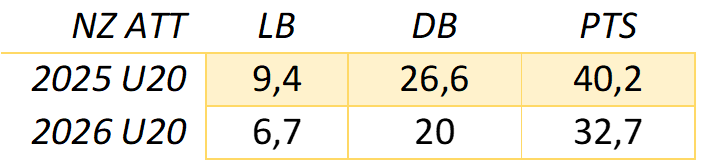
Comparison in attack of 2025 and ’26 NZ U20s: the 2025 cohort had a greater offensive output across the board
The key to fixing the defence – playing a possession game – is strongly connected to the closed door on attack. The NZ U20s kept the ball in hand for long stretches of time but struggled to break the opposition defensive line. Of the traditional powerhouses at this level (SA, FRA, ENG, ARG, AU), New Zealand had the most attacking touches per clean break (38.1), compared to just 24.1 for an attack like Argentina’s.
It shows a side that was successful in recycling the ball and securing possession but less so in actually generating clean breakthroughs. Coinciding with this was the team’s inability to beat defenders: of the top 9 teams in the tournament, the NZ U20s were ranked last for defenders beaten per 80, at just an average 16.2 defenders beaten per game. Again, compared to sides like South Africa (31), Argentina (33.8), France (27.2), and Australia (25), the Baby Blacks’ attack lacked dynamism.
A lack of offloading
Again, this can be linked to the style of play. Typical to a possession game is a cautious ball-in-hand approach, trying to limit team errors in order to retain the ball. Joe Schmidt teams, especially his Ireland side from 2013 to ’19, were famous for limiting the offload, viewing it as a high risk, low reward play. A similar mindset pervaded this NZ U20 team: their turnover rate was relatively low (13.4 TO per 80) but they also had the lowest offloading rate of the top 9 teams, at just 4.2 per game. When putting together the offload rate and the rate of defenders beaten per 80, a correlation does seem to appear.
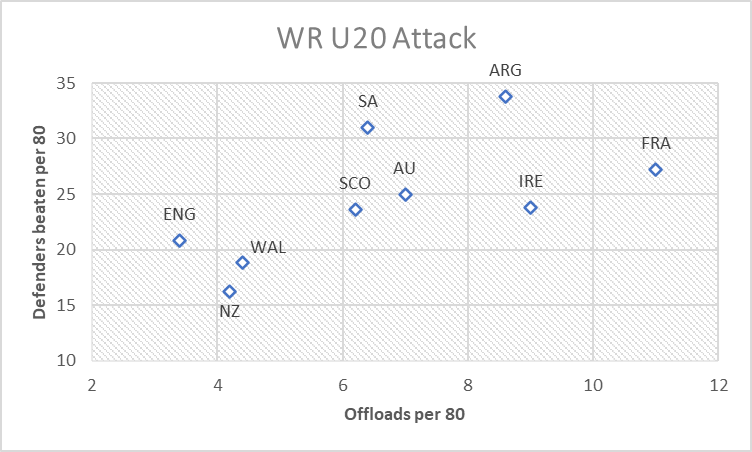
Teams with the lowest offload rate – New Zealand, Wales, and England – are cluttered together as the teams who also beat the least defenders on average
Here, the possession game shows its double-edged nature, where its defensive benefits can negatively impact the team’s attacking capacities. A low-offloading possession team, of course, doesn’t have to be a poor attacking team: the 2022-’23 Ireland side were a heavy possession-based team, yet were the premium attacking force of that World Cup cycle. The key for them, however, was a backline that perfectly knew its responsibilities in attack and were impeccably drilled in their running lines and off the ball positioning.
Complexity of the shape
There were signs that the NZ U20s definitely tried to meet those particular thresholds but those demands were always going to be ambitious for a rep side that was only ever going to play 8 games together. The team itself certainly didn’t lack in attacking ambition: watching the games from the perspective of the NZ attacking shape, the side shifted between a 1-3-3-1, 1-3-2-2, and 2-4-2, all of these different pod set-ups allowing for a different approach and emphasis in attack.
The main difference would be between whether they would put a 3 or 4 man pod of forwards in the middle: while the 3 man pod allows the forwards to spread themselves alongside the width of the field, the 4 man pod gives the advantage of a more condensed opposition defensive line, giving the backs more space out wide to manipulate.
When everyone knew their roles, things tended to work very well. In the game against Scotland, for example, the NZ U20s have a lineout around their own 40 metre line. After securing the ball, Sinton and Muliaina pass into midfield for a Mauga hit up. After securing the ball, Sinton swings the ball back to the blindside, the forwards having realigned into two pods of two. Sinton and Muliaina both pass behind the pods to a looping Lewai, who uses the blocking lines of the second pod to free up Tocker out wide. If Tocker would’ve found the trailing Findlay, an even bigger dent into the Scottish defensive line could’ve been made.
The backline is fully set for a strike out wide and Norrie uses the Scottish defence’s anticipation against them. Norrie isn’t too dissimilar to a player like Beauden Barrett in the middle of the field, who often used the threat of his outsides as a way to break the line with a burst of speed
Such fluidity and cohesion was, unfortunately, too rare throughout the tournament, with players often being out of position or not quite getting their running lines right. Below are just two examples from the Italy pool game, where a lack of familiarity results in the Italian defence being able to easily read the NZ attack.
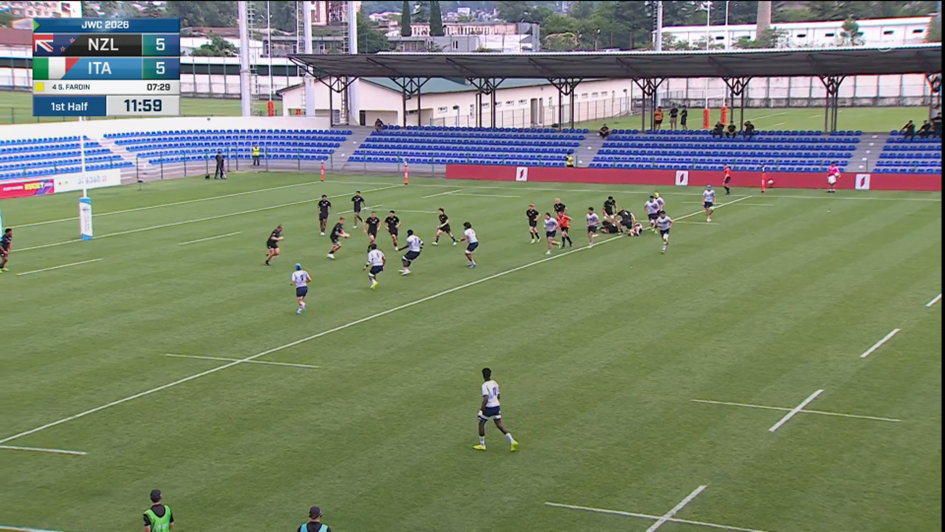
Here we see a pod of 4 forwards but the crucial backdoor option is missing: without a back floating behind, there’s no realistic option to get the ball out wide, which is the whole point of the 2-4-2. I think someone, either Pahulu or Etuale, have missed their assignment here, making it easy for the Italian defence to know that a carry is coming.
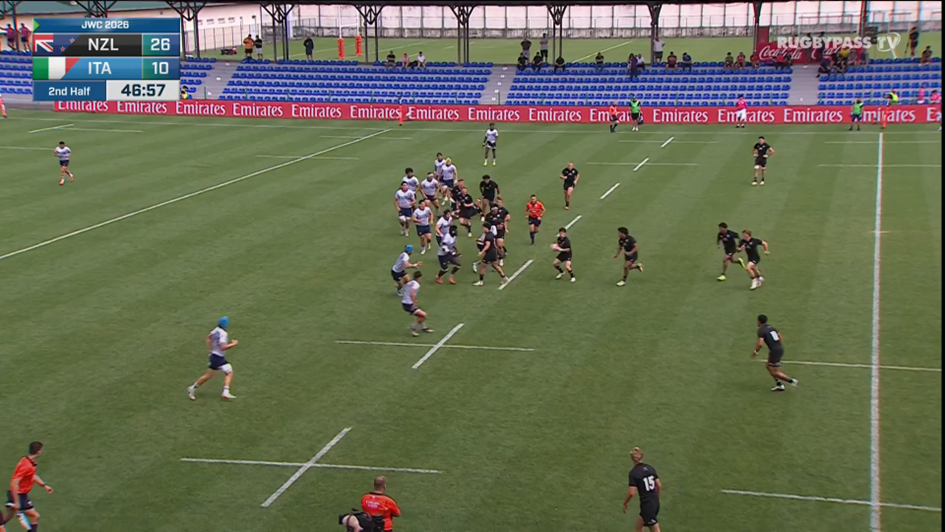
This, on the other hand, is an example of a nicely created situation but one that is eventually foiled by rather ugly execution: while there is a technical overlap, there are only two realistic passing options (Pahulu and Etuale), which means that the defence isn’t stressed. It, once again, shows the ambition but also the difficulty of NZ U20 attack, which expects a lot of its backs in terms of off ball movement and handling skills. Players like Pahulu, Guerin and Etuale are all still eligible next year so they do have the time to further refine their knowledge of the system and its positional requirements.
Selection struggles
One final aspect of the possession game conundrum that I wish to briefly highlight concerns selection. As I’ve already mentioned, selectorial decisions seemed to favour ball retention and low turnover rate. In terms of halfbacks, one then quickly arrives at the combination of Charlie Sinton and Mika Muliaina. Sinton is a combative halfback who is incredibly staunch on defence while Muliaina is an excellent organizer who sees the field well. The issue, however, is their combination: neither are particularly adept at attacking the line, which means that defences could too easily drift onto the edge. Looking at their combined runs and line breaks in comparison to the other top halfback pairings, this lack of threat at the line is further confirmed.
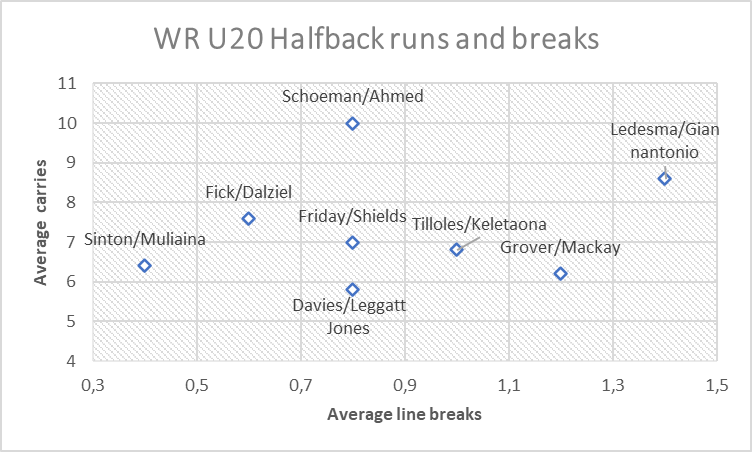
The combination of Sinton and Muliaina both ran too rarely while also failing to present a line break threat
From this point of view, starting Norrie at first five alongside Sinton or bringing a running halfback like Miln to pair with Muliaina might have been a more balanced approach, with the added inside threat creating more space for the outsides. In Norrie’s two starts at 10, against Italy and England, he broke the line 3 times while Sinton probably had his best game against the Italians, focusing simply on quickening the pace from the ruck.
All of this is of course easy to say after the facts. Jury’s decision to play a possession game ultimately was a reasonable decision, especially with the results at U18 level in the back of the coaches’ minds. But if there’s anything to be learned, it’s probably that, even in the face of an undeniable reality, it is important to keep asking unexpected questions. You never know what door it might end up opening.
Tl;dr
After some poor defensive showings at U18 level in 2024 and ’25, expectations were low for this particular group. Some creative thinking from the coaching staff through the implementation of a possession game, as well as an increased defensive desire from the playing group has turned this cohort from one of the worst U18 defences into a clear top 3 defence at the U20 World Championships. A third place finish is, in this sense, more than admirable.
Still, every solution to a problem brings along new challenges. The NZ U20s ultimately failed to really click on attack in the way they did at times in 2025, finding it more difficult to break the line, beat defenders, and rack up points on the scoreboard. In the end, they were a showcase of the difficulties that can arise with a possession game: becoming hesitant to push an offload, taking the safe option, and becoming more concerned with recycling the ball than actually pushing through the defensive line.
If the coaching team persists with this system next year, their growth might lie in a further developed cohesion amongst the backs: players like Muliaina, Pahulu, Guerin, and Etuale are all likely to feature once again, more knowledgeable about both system requirements and each other’s playing tendencies.