
The speed of attack has become crucial in today’s game: this weekend’s France versus England Test was yet another great example of how the highest levels of the game are currently moving at a breakneck pace, the speed of the attack simply overwhelming the defence. England’s first score of the night nicely encapsulated this.
Off a Dupont box kick, England build a total of 7 rucks. Off those 7 rucks, 6 of them were lightning quick (LQB), taking 3 seconds or less for the ball to be recycled and moved away from the ruck.
Throughout the sequence, England use a relatively traditional 1-3-3-1 shape, with two groups of tight five forwards (+ Pepper) in the middle and Chessum and Earl on the edges. Three things, however, make the shape very potent: (1) the aforementioned quickness of delivery, (2) the interplay of the forwards, consistently shifting the point of attack before contact, and (3) Fin Smith’s play at the line, both attacking the defence himself as well as playing out the back.


First English scoring sequence: Itoje with the short pass at the line; Coles, Smith and Spencer shifting the point of attack at the line; and finally, Fin Smith outflanking the French defence
With the French defence unable to stifle momentum through a lack of dominant hits and breakdown pressure, the English attack is able to outflank its opponent, allowing Roebuck to dot down in the corner.
It’s much the same for the second English score: from a lineout just outside the French 22, England build just 5 rucks, but each of them across the gain line and under 3 seconds. While the shape is different – both Chessum and Earl now attacking through the middle – the principles remain the same: use lightning quick ball to get behind the French defensive line and let the halfbacks (Spencer and Smith) orchestrate strikes through either hands or the boot.

The French defence is unable to keep up with the attack and miss out on Fin Smith swinging back to the blindside for Spencer's grubber
Speed was also the deciding factor for the French scores. But while the English generated momentum through building quick rucks, the French on the other hand attempt to avoid building rucks altogether, preferring instead to keep the ball alive at first or second phase, and attack the available space from the off. The first two French scores required just the one ruck in total, a crash ball from Matiu in midfield. The rest was just clean kick execution towards the space by Ramos and Jalibert, with Bielle-Biarrey on hand to finish.

Ramos kick

Jalibert kick
While you could argue that this is ‘bad defence’ – similar to how Ben Smith just argued for RugbyPass – the reality is that any defensive realignment towards anticipating LBB’s line here will simply create a different space to attack for Jalibert. When you have playmakers as skilled as Jalibert and Ramos, any defensive scheme will have certain weaknesses.
SRP: lightning quick ball but mixed degrees of direction
England have led this year’s Six Nations in LQB (60% of their rucks are between 0 and 3 seconds) but their attack has only clicked against Wales and France. This is also indicative of the fact that quick ball in itself isn’t enough to create a potent attack. What you also need is direction, from halfbacks that steer the attack towards the right part of the field and are able to get the ball where the defence is at its weakest.
Fin Smith carried the ball 7 times for 27 metres against France, and while this might not seem like a massive number, his ability to take on the line had a massive effect on the French defensive line. Similarly, Dupont, Jalibert and Ramos displayed pinpoint accuracy with their boot and their decision-making, creating multiple tries for France through sheer skill execution.
Furthermore, the shape of your attack matters as well. If you have quick ball but the halfback has no real potent attacking options surrounding him, then the chances are high your attack is going nowhere.
So, with all this in mind, how does Super Rugby stack up at the moment? In terms of quick ball provided, Super Rugby is clearly of international standard, with most sides averaging 50% or more ruck speed of 3 seconds or less.
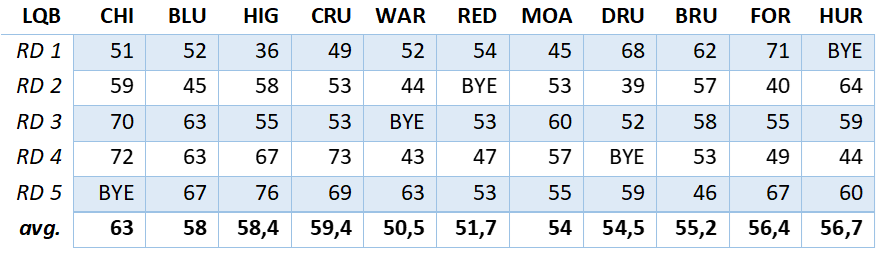
Super Rugby is still a fast-paced competition (stats from RugbyPass)
This compares favourably to a competition like the Six Nations, where the sides average between 44.8 (ITA) and 60% (ENG) of lightning quick ball. A side like the Chiefs, for example, are currently averaging quicker ball than any Six Nations side, while the Highlanders’ 76% quick ball against the Crusaders in Round 5 represents the highest recorded percentage across the competitions.
But the caveats quickly appear here. Because while the Highlanders had plenty of quick ball at Apollo Projects Stadium, they had very little to show for it, with just the 18 points and 5 line breaks on the stat sheet. A comparison to the France-England game quickly makes apparent what the men from the South were lacking. While Ben Spencer and Fin Smith were bossing the English attack, putting variety into their shapes and attacking the line with intensity, the Landers halfbacks were unable to provide similar incision.
Fakatava and Millar combined for just 8 runs and 31 metres, a low number considering the amount of opportunities to attack the seams from quick ball. They were mostly content to go either vertical or lateral, hoping for opposition errors or some magic from Tangitau or Tavatavanawai. Such straightforwardness, however, is easy to defend, the Crusaders defence swallowing up an attack that is easy to read.
That represents a missed opportunity because when Millar did decide to run, it clearly spooked the Crusaders’ defence.

Millar half break
The Highlanders attack in the 63rd minute is a good example of why quick ball in itself doesn’t mean very much. Tavatavanawai is launched inside the Crusaders 22 off a set piece attack, and while the Landers are able to generate quick ball (< 3 seconds), at no point does the point of attack shift at the line (short passing, offload after contact). It’s just one-off runners, making it rather predictable and easy to defend. The Highlanders can’t cross the gain line and are eventually turned over by Fainga’anuku.


Quickly going nowhere: the Landers attack is unable to dent the Crusaders defence through a lack of variety
This can be contrasted to the Crusaders’ approach to quick ball and, especially, their halfbacks role in exploiting such ball. Both Hotham and Reihana tried to switch up play, attacking the line from 10 or sniping around the ruck, combining for 14 runs and 76 metres carried. Whenever Hotham sniffed an opportunity, he wouldn’t hesitate to run at the space.


Exploiting lightning quick ball: Hotham runs at the space around the ruck
This approach also led to different outcomes inside the opposition 22: whereas the Highlanders lack variety, the Crusaders tried to consistently shift the point of attack, attacking where the Landers defence was weakest. In the first half, from a tap penalty, Hotham passes left after a right decoy run from the forwards. Reihana attacks the line and offloads back inside to Ennor. With a quick recycle and the Landers defence in shambles, Newell can basically fall over onto the try line.

Reihana attacks the line
Similarly, in the 65th minute, with the Crusaders hot on attack off of turnover ball, Reihana is presented the ball just inside the Highlanders 22. Rather than further passing along the chain to the openside, he swings the ball back to the blind, to where an open Will Jordan is faced with a bunch of tight 5 forwards. While the try is disallowed for obstruction, it shows clear principles of how to exploit the benefits of quick ball.

Reihana shifts the point of attack
Tl;dr
While the North’s recent scoring extravaganza is considered by some to be caused by poor defence, the reality of it is, is that attacking efficiency is reaching new heights. Combining lightning quick ball with multi-skilled halfbacks is a nightmare to defend for any team, below or above the equator.
So how is Super Rugby stacking up? The competition as a whole is providing quick ball but in terms of halfback direction and attacking shape, it is more of a mixed bag. Simply producing quick ball isn’t enough: the team also needs decisive and skilled playmakers, as well as players (forwards or backs) able to shift the point of attack close to the line. While some seem to have lost their running game (Fakatava), others, like Hotham and Reihana, are growing in confidence, attacking the line and creating a complex picture for the defence to read. Further polish some of their other skills and the points will rack up in Super Rugby as well.